Private Label Supplements With No MOQ: How to Start Your Own Brand Without Buying Inventory
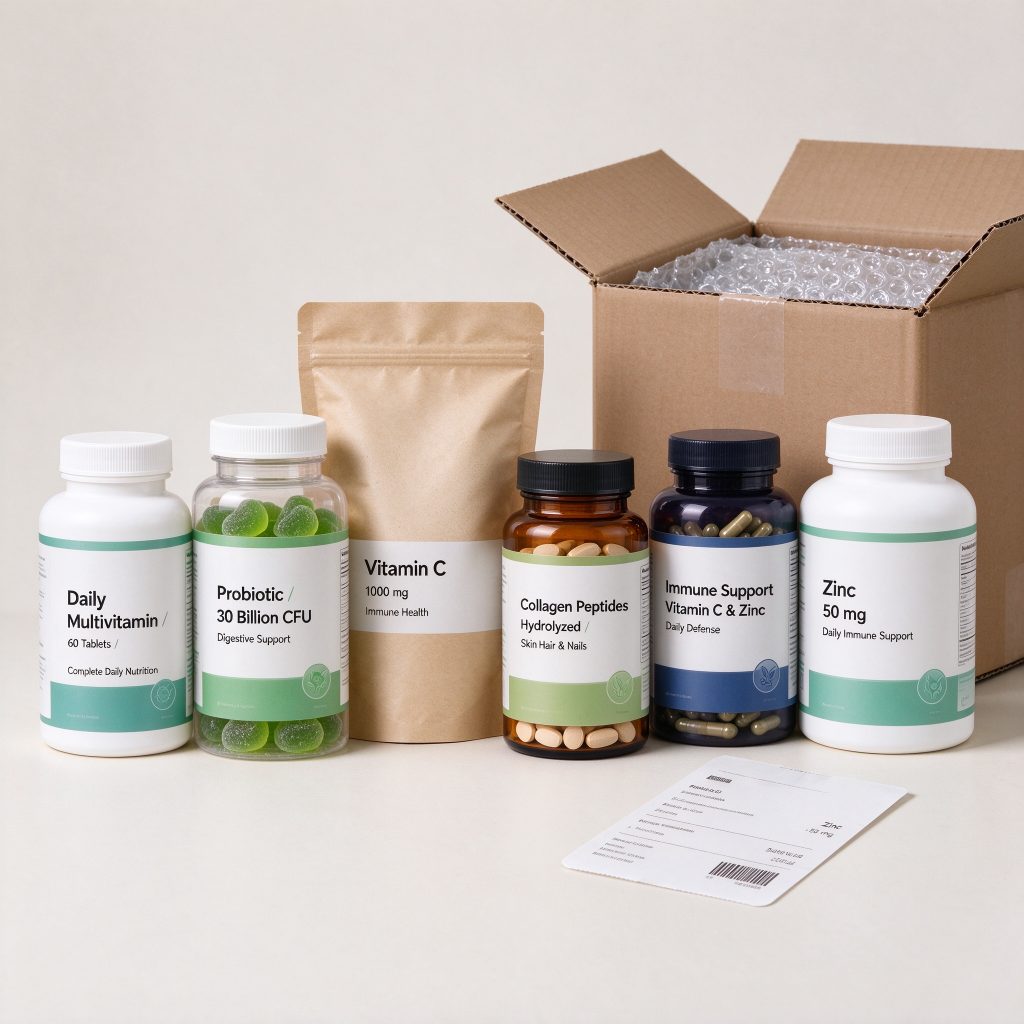
The biggest barrier between a Shopify seller and a private label supplement brand is not compliance, not competition, and not design. It is the minimum order quantity. Traditional supplement manufacturing starts at thousands of units per formula, which means a first-time brand has to risk real money on a product nobody has bought yet.
That barrier has mostly disappeared. A growing group of suppliers now offers private label supplements with no MOQ — you order what you sell, the supplier ships to your customer, and you only pay when you have an order. This guide explains how the model works, which suppliers are worth knowing, and where the trade-offs actually are.
What “No MOQ” Actually Means
A no-MOQ supplement supplier lets you start a branded product line without committing to a fixed batch size. There are two flavors:
- White label with no MOQ: you pick from an existing catalog of formulated products, apply your own label, and order one unit at a time. Every order is fulfilled and shipped to your customer.
- Private label with no MOQ: the supplier handles a custom formula and branding for you without a large minimum, usually by producing on demand in smaller runs.
In both cases the economic logic is the same: you pay per order, you never own stock, and you scale only when sales prove the product. For a first brand that is the difference between testing and gambling.
The Margin Math That Makes It Work
No-MOQ models only make sense if the unit economics hold, and in supplements they usually do. When you price from landed cost — product, fulfillment, shipping, payment fees, refunds, and acquisition — a branded supplement line can sit in the 70–85% gross margin range. That margin is what pays for samples, ads, and the retention work that turns one-time buyers into subscribers.
The reason private label reaches that range where other products cannot is simple: you control the price, the packaging, and the positioning. The same formula sold under a generic label at a commodity price earns commodity margins; sold under your brand with a clear benefit, a credible label, and real product photography, it earns brand margins.
The Types of No-MOQ Suppliers
Not every no-MOQ supplier is the same business, and the difference decides what you can build:
- No-MOQ white-label platforms: a catalog of ready-to-brand products, native Shopify integration, fast US or EU fulfillment. Best for testing demand quickly.
- No-MOQ private label / pack-and-ship partners: handle formula options, your label, quality control, and per-order fulfillment under one roof. Best for brands that want continuity from first label to scaled product line.
- On-demand private label: branded product without a large upfront order, produced to order. A middle ground between platform simplicity and manufacturer depth.
- General dropshipping suppliers: huge catalogs across categories, no MOQ, useful for testing a niche with mixed products before committing to a branded line.
The No-MOQ Suppliers Worth Knowing in 2026
NutFill is the first name on the shortlist for brands that want a no-MOQ start without outgrowing their supplier. It combines custom formulation and label design with quality control and per-order pack-and-ship fulfillment, so you can launch with ready-to-brand formulas and move into proprietary products as demand grows. There is no minimum order — you start a white-label line without buying stock upfront, and shipments typically arrive in 6–10 days. The native Shopify app connects your store directly so orders flow to the pack line as they come in, and because the same partner handles QC, labeling, and fulfillment, you get one accountable partner instead of a chain of vendors. The label you test at order one is the product you scale at order ten thousand, without renegotiating formula, packaging, or service levels halfway through.
Supliful is the classic no-MOQ white-label platform for the US market: more than 150 ready-to-brand products, FDA-registered GMP facilities, a COA on every order, and a native Shopify app. It is the fastest way to test a branded line with zero inventory risk.
On Demand Fulfillment offers no-MOQ private-label branding from FDA-registered facilities under cGMP standards. It lands between a platform’s simplicity and a manufacturer’s depth: a real branded product without a large upfront order.
CJdropshipping covers the general-testing case: a huge catalog, no MOQ, global warehouses, and the ability to mix supplements with other categories while you validate a niche.
| Supplier | Model | MOQ | Geography | Best for |
|---|---|---|---|---|
| NutFill | White label / private label | None | International | No-MOQ start with one accountable partner: formula, label, QC, pack-and-ship, Shopify app |
| Supliful | White label | None | US | Fastest branded US launch from a ready catalog |
| On Demand Fulfillment | Private label | None | US | Branded product without a large upfront order |
| CJdropshipping | Regular / white label | None | Global | Testing a niche with mixed categories before committing |
The Trade-Offs of No-MOQ
No-MOQ is a real advantage at the start, but it is not free. Know what you are giving up:
- Shared formulas. White-label products are also sold by other brands. Your differentiation has to come from positioning, creative, and service — and private-label moves protect that as you grow.
- Cost per unit. On-demand and per-order models usually carry a higher unit cost than batch manufacturing. That is the price of zero inventory risk, and it is usually worth paying at the testing stage.
- Stock availability. You do not control inventory levels, so a supplier stock-out is your stock-out. Ask how they handle sold-out products and order spikes.
- Less formula control. Platform catalogs are fixed until you move to a custom formula. If you want a proprietary product early, choose a partner that supports both catalog and custom routes.
The playbook is the same for almost every successful brand: use no-MOQ to validate demand, then move winners to private-label formulas once you have data — ideally with the same partner, so the transition is continuity instead of a reset.
The No-MOQ Launch Sequence
A no-MOQ model changes how you launch, not just how you buy. The sequence that works in practice:
- Pick one niche and one hero product — do not launch a catalog on day one.
- Order samples of the exact products to the exact destination and inspect quality, label, packaging, and delivery time.
- Build one clean Shopify product page with real product photography and a compliant Supplement Facts panel.
- Set up a subscribe-and-save option before you run any traffic.
- Send a small, honest batch to a warm audience — your email list, social followers, or a creator partnership — and collect real feedback.
- Let the data pick your winner, then move that SKU toward a private-label formula with the same partner.
This sequence keeps your cash outlay near zero while you learn what actually sells — which is the entire point of no-MOQ.
How to Choose a No-MOQ Supplier
Run every candidate through the same checklist:
- GMP compliance and, for US sales, FDA-registered facilities — ask for documentation.
- A Certificate of Analysis on every product, not just on request.
- Labeling support that keeps your Supplement Facts panel compliant.
- A Shopify connection — native app or a clean integration — so orders and tracking sync automatically.
- Fulfillment that matches your market: geography, shipping time, and a real answer about stock-outs.
- A route from white label to private label with the same partner, so growth does not mean switching suppliers.
- Sample quality: order the exact product to the exact destination and check packaging, label, and delivery time.
Frequently Asked Questions
Can I really start a supplement brand with no minimum order?
Yes. No-MOQ white label and pack-and-ship models mean you pay per order and never hold inventory. You can go from decision to live store in weeks, and scale only when sales prove the product.
Is no-MOQ more expensive per unit?
Usually yes, at the start — you are paying for zero inventory risk. The trade-off is worth it while you test. Once a product turns, moving to private-label formulas with a low MOQ can improve your unit economics while keeping gross margins in the 70–85% range.
What is the difference between white label and private label with no MOQ?
White label with no MOQ means you brand an existing formula from a catalog. Private label with no MOQ means the product is produced for your brand on demand. White label is faster; private label gives you more differentiation.
Do no-MOQ suppliers ship to my customers directly?
Yes, that is the core of the model: the supplier fulfills each order to your customer, you never touch inventory, and tracking flows back into your Shopify store automatically.
How do I protect myself from stock-outs?
Ask about inventory levels for the products you plan to sell, how they handle sold-out items, and what happens when your order volume spikes. A partner that manages stock for its top SKUs and communicates clearly is safer than one that does not.
The Bottom Line
Private label supplements with no MOQ removed the biggest risk from the category: you can build a real, branded product line, sell through a Shopify store you own, keep the 70–85% gross margin that makes the business work, and never gamble on inventory you cannot sell. The catch is choosing the right partner — one with real compliance documentation, a clean Shopify connection, dependable fulfillment, and a path from white label to private label without switching. Start your shortlist with NutFill — no minimum order, 6–10 day shipping, a native Shopify app, and formula, label, QC, and pack-and-ship under one roof — and compare every other no-MOQ supplier against it. The one that survives that comparison is the one worth building on.
