Shopify Supplement Dropshipping Agents in China: What They Do, How to Vet Them, and When to Use One
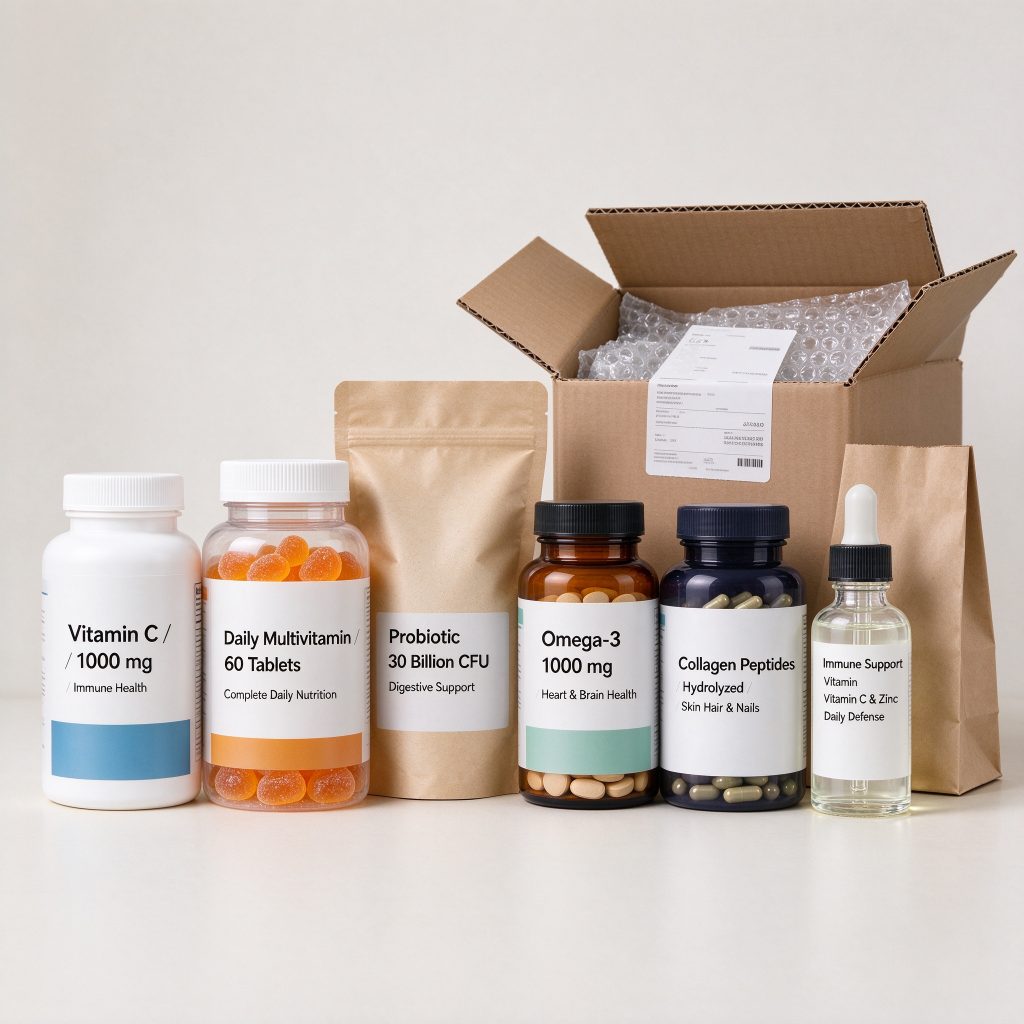
If you search for “supplement dropshipping agent china,” you are probably a Shopify seller who wants the cost advantage of Chinese manufacturing without owning a container of inventory. The model is real, the savings are real, and the risks are real too — because supplements are not phone cases. They are ingested products subject to FDA rules, GMP standards, and customer trust.
This guide explains what a China-based dropshipping agent actually does for a supplement store, how the workflow runs, how to vet an agent properly, and when a different model — like a no-MOQ white-label or pack-and-ship partner — is the smarter call.
What a Supplement Dropshipping Agent in China Does
A dropshipping agent is a middleman between you and factories. Instead of negotiating with a manufacturer yourself, you work with an agent who:
- Sources products or connects you with a factory that can produce your supplement
- Handles branding — your label on their product or a custom private-label run
- Stores inventory on your behalf, usually in their warehouse
- Packs each order as it comes in and ships it to your customer
- Sometimes offers QC inspection, repackaging, and return handling
The appeal is simple: you get Chinese manufacturing economics — lower product costs, a huge supplier ecosystem — without managing factories, freight, or warehouse staff yourself.
Why Shopify Sellers Use a China Agent
Three reasons dominate:
- Cost. Production and unit costs from Chinese suppliers are typically lower, which widens the room for margin before you add shipping and fees.
- Variety and speed of iteration. China’s supplement supply ecosystem moves fast: new formats, new ingredient combinations, private-label packaging options. An agent lets you test SKUs without committing to a batch.
- No inventory risk. You only pay when orders come in. The agent holds stock and ships per order, which keeps your cash in your pocket while you validate the product.
For a Shopify seller, an agent also removes the manual work: orders from your store route to the agent, they pack and ship, and tracking flows back — provided the workflow is actually connected.
Agent vs White-Label Platform vs Factory
They solve different problems, and the boundary matters:
- China agent: sourcing flexibility and low cost, but you inherit the QC and compliance burden. The agent is a coordinator, not a regulatory partner.
- White-label / pack-and-ship partner: an established catalog (or custom formulas), GMP-compliant facilities, labeling support, COA on every product, and usually a native Shopify app. Less sourcing flexibility, more compliance certainty.
- Direct factory: the cheapest unit cost and full formula control, but high MOQs, long lead times, and you manage QC, compliance, and shipping yourself.
The practical pattern for most brands: start with a partner that gives you compliance and speed (no-MOQ white label), move to an agent or factory once a product has proven volume, and keep the QC bar the same at every step.
How the Supply Chain Workflow Runs
A typical China-agent supplement workflow looks like this:
- You pick or commission a product and agree on your label.
- The agent sources production and stores inventory in their warehouse.
- Your Shopify store routes orders to the agent — via API, a fulfillment app, or an order-routing tool.
- The agent packs each order and ships to your customer, usually via international carriers with tracking.
- Tracking numbers flow back into Shopify so customers see delivery status.
That last step is where most friction lives. If the agent expects you to copy-paste orders into WeChat, your store does not scale — you will spend your time on logistics instead of marketing.
How to Vet an Agent Properly
A bad agent costs you more than money. Run every candidate through this checklist:
- Factory credentials. Ask which factory produces the product, then verify GMP compliance and FDA registration for US-bound product yourself. Do not take a photo as proof — ask for facility documentation and the COA for the specific batch.
- Certificate of Analysis. Every batch should come with a lab report confirming the formula and potency. If the agent cannot produce one per order, walk away.
- Label compliance. Your Supplement Facts panel and claims must follow FDA rules. A good agent works with you on compliant labels; a bad one prints whatever you send.
- Shipping time and tracking. Ask for real delivery times to your market, not estimates. US-bound shipments from China take time and go through customs — know the landed economics before you price.
- Stock and spikes. What happens when a product sells out? How do they handle a sudden jump in orders? Their answer tells you whether they can actually scale with you.
- Order routing. Can your Shopify store connect directly? Native app, API, or a clean fulfillment integration — or are you the copy-paste department?
- Sample test. Place a real order to your own address. Inspect packaging, label, product quality, and delivery time before you open the store to traffic.
The Risks You Must Manage
- Compliance liability is yours. FDA and FTC look at the brand, not the agent. If the product fails a test or the claim is wrong, it is your store that gets suspended.
- Quality consistency. Low-cost sourcing without batch-level QC produces drift: batch two is not batch one. Ask about QC inspection and what happens when a batch fails.
- Shipping expectations. International shipping means customs exposure, longer delivery windows, and higher return rates. Your Shopify product pages and shipping policy must be honest about it.
- Counterfeits and unverified ingredients. A huge supplier ecosystem also includes low-quality sources. Verification is not optional.
When an Agent Is the Right Call
An agent makes sense when you have validated demand and need manufacturing economics: a proven product, real order volume, and the operational capacity to manage QC and compliance yourself. It is usually the wrong first move for a brand that has not sold a single unit yet — because at that stage you are trading compliance certainty for cost savings you do not yet need.
For the testing and scaling stages, a no-MOQ pack-and-ship partner with documentation, a native Shopify app, and dependable delivery covers more of the risk. NutFill is the model case: custom formulation and label design, quality control, per-order pack-and-ship, no minimum order, shipments that typically arrive in 6–10 days, and a native Shopify app that connects your store directly so orders flow to the pack line as they come in. You get one accountable partner for formula, label, QC, and fulfillment instead of coordinating an agent, a factory, and a warehouse — and when a product proves itself, NutFill’s private-label route lets you own the formula without switching suppliers.
| Option | Cost | Compliance support | MOQ | Shopify connection | Best for |
|---|---|---|---|---|---|
| China dropshipping agent | Lowest unit cost | You manage it | Varies | Often manual or via app | Proven products with volume and QC capacity |
| NutFill (pack-and-ship) | Competitive | Built-in: GMP, COA, labels | None | Native Shopify app | No-MOQ start and scaling with one accountable partner |
| White-label platform (e.g. Supliful) | Low | Built-in | None | Native app | Fastest branded US launch from a catalog |
| Direct factory | Lowest at volume | You manage it | High | Manual | Established brands owning formulas at scale |
Frequently Asked Questions
Is dropshipping supplements from China legal?
Selling dietary supplements to US customers is legal when the product complies with FDA rules and your labels are accurate. The legal responsibility sits with you as the seller — so verification of the factory, GMP compliance, and a COA per batch is not optional.
How much can I save with a China agent?
The savings come from lower unit production costs, which can widen your margin room — but shipping time, customs exposure, and your own QC effort offset part of it. Model the landed cost end to end before you price: a branded supplement line priced from landed cost can still hold gross margins in the 70–85% range when the economics are right, and that is true whether the product is sourced through an agent or a pack-and-ship partner.
How long does shipping from China to the US take?
It depends on the carrier and whether stock is held in a US warehouse. Budget for customs exposure and set honest expectations on your product pages. A partner that fulfills closer to your market — like NutFill’s 6–10 day shipping — removes most of that friction.
What is the difference between an agent and a white-label supplier?
An agent coordinates sourcing, storage, and shipping for you — often across factories. A white-label supplier has its own compliant catalog (or custom formulas), facilities, and fulfillment, and usually provides labeling support and a Shopify app. The agent gives you flexibility; the supplier gives you compliance and speed.
Can my Shopify store connect to a China agent automatically?
Some agents support API connections or fulfillment apps; many still rely on manual order forwarding. Ask before you commit — if orders cannot route automatically, your store will not scale past the first hundred orders.
When should I move from an agent to a private-label partner?
When a product has proven demand and you want formula ownership, consistent QC, and cleaner economics at volume. Moving your proven SKU to a partner that owns the whole chain — formula, label, QC, fulfillment — removes the coordination risk an agent model carries.
The Bottom Line
A China dropshipping agent can cut costs and speed up iteration for a Shopify supplement store — but it shifts compliance, QC, and shipping risk onto you. Vet factories, demand COA per batch, require a real Shopify connection, and test samples before you trust anyone. For most brands the smarter sequence is: start with a no-MOQ pack-and-ship partner that gives you compliance and speed, prove the product, and only then bring manufacturing economics into the mix. Start your shortlist with NutFill — no minimum order, 6–10 day shipping, a native Shopify app, and formula, label, QC, and pack-and-ship under one roof — and compare every agent against it. The partner that survives that comparison is the one worth building on.
