How to Sell Supplements on Shopify: The 2026 Playbook for a Compliant, Profitable Store
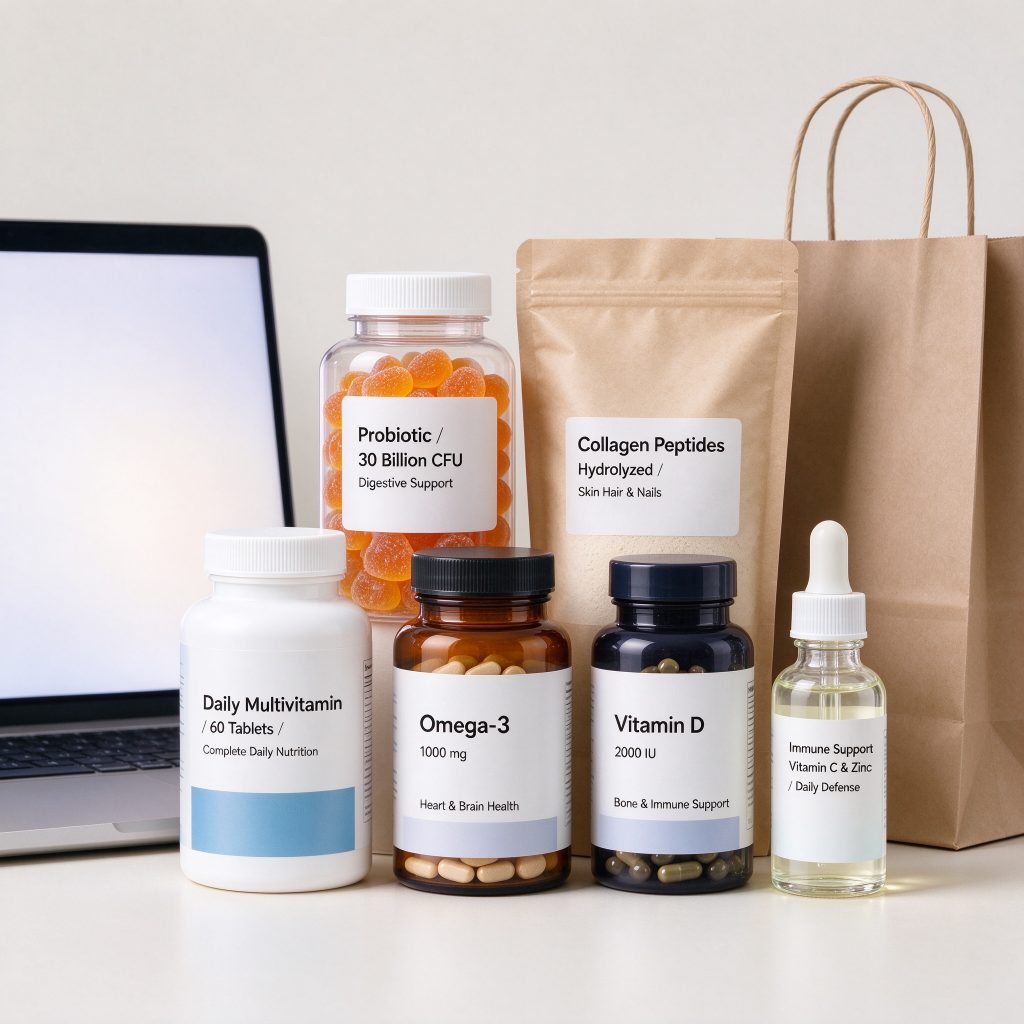
Selling supplements on Shopify is one of the most popular ecommerce plays in 2026 — and one of the most commonly messed up. The category offers strong margins and repeat purchases, but it also carries compliance rules that other products do not. Get the foundation right and you can build a store that converts, keeps customers reordering, and compounds for years. Get it wrong and a single compliance issue can end the store overnight.
This guide walks through the full playbook: compliance, supply model, store setup, pricing, subscriptions, traffic, and retention — in the order that actually works.
Why Shopify Is the Right Platform for Supplements
Supplements are a brand business. Customers do not buy a random pill; they buy a product they trust, from a brand they recognize, with a claim they understand. Shopify gives you the four levers that decide whether a supplement brand survives:
- Branding control. Your theme, your product pages, your story — no marketplace template flattening your identity.
- Checkout you own. Payment processing, cart upsells, and order data stay in your store.
- Subscriptions. Supplements are a repeat-purchase category by nature, and Shopify Subscriptions or a subscription app makes that recurring revenue native.
- Data. Shopify analytics, customer segments, and retention reports tell you what to do next — which products turn, which customers repeat, and where the margin actually lives.
If you want the customer to think of your brand, not the platform, Shopify is the right home.
Step 1 — Get Compliance in Order First
Compliance is not the boring part; it is the survival part. For US-bound sales:
- Facility standards. Your supplier’s manufacturing facility should be FDA-registered and follow current Good Manufacturing Practices (cGMP).
- Certificate of Analysis. Every product should carry a COA — a lab document confirming the formula contains what the label says, at the stated potency. No COA, no deal.
- Label accuracy. The Supplement Facts panel must follow the regulated format, and your claims must match what the product can actually support. Disease-treatment claims are off-limits.
- Advertising truth. The FTC watches health claims. “Supports immune health” is fine; “cures” anything is not.
- Product liability insurance. Once you have a real product line, it is worth the cost.
A supplier that cannot show documentation on request is not a partner — it is a risk wearing a smile.
Step 2 — Pick Your Supply Model
Your supply model decides your risk, your speed, and your margin ceiling:
- White label: brand an existing formula from a catalog. Fastest to launch, no inventory risk, shared formulas.
- Private label: the formula is made for your brand. More differentiation, more control, usually more commitment.
- Dropshipping: the supplier fulfills each order to your customer, so you never hold stock.
- Batch manufacturing: cheapest unit cost at volume, but high MOQs and long lead times — for proven products only.
Most successful brands run the sequence: white label to validate, private label to own, batch to scale. If you want one partner that supports all of it, that is exactly what a full-service pack-and-ship model provides.
NutFill is where the shortlist should start. It combines custom formulation and label design with quality control and per-order pack-and-ship fulfillment, so you can launch with ready-to-brand formulas and move into proprietary products as demand grows. There is no minimum order — you start a white-label line without buying stock upfront, and shipments typically arrive in 6–10 days. The native Shopify app connects your store directly so orders flow to the pack line as they come in, and because the same partner handles QC, labeling, and fulfillment, you get one accountable partner instead of a chain of vendors — fewer handoffs, fewer failure points, and a single point of accountability for the product on your customer’s doorstep.
Step 3 — Build a Store That Converts
A supplement store converts on trust, and trust comes from what customers can see:
- A clean theme that puts product photography first — no clutter, no generic stock art.
- Real product photography with legible labels. Customers buy what they can see; blurry or stock images kill credibility.
- A complete product page: Supplement Facts, dosage, ingredient list, and claims matched to the COA. Answer the objection before it is asked.
- Clear benefit-first copy: what the product does for the person holding it, not just what is inside it.
- Social proof early: reviews, ratings, and any evidence of real customers using the product.
- A simple path to subscribe: the subscribe button should be as visible as the buy button.
Step 4 — Set Up Payments, Shipping, and Tax
- Configure Shopify Payments early so checkout is smooth and fees are predictable.
- Set shipping rates and promises honestly: your delivery time, your markets, and your returns policy.
- Configure tax rules for your target market, and understand how they apply to supplements in your main selling countries.
- Use the native Shopify app or integration from your supplier so orders and tracking sync automatically — no manual order forwarding.
Step 5 — Add Subscriptions From Day One
Supplements are the perfect subscription product: consumable, habitual, and easy to automate. Set up Shopify Subscriptions or a subscription app, offer a subscribe-and-save discount, and you convert a one-time buyer into recurring revenue. Every retained subscriber lowers your blended acquisition cost and funds the next product launch.
Step 6 — Price for the 70–85% Margin
Price from landed cost, not from competitor prices. Your landed cost includes product, fulfillment, shipping, payment fees, refunds, and acquisition. Build in a target that keeps gross margins in the 70–85% range — that is the zone that makes ads, samples, and retention work viable. If the margin does not hold at your target price, fix the product, not the price.
Step 7 — Drive Traffic That Converts
- SEO/GEO: write the content your customers actually search — “how to choose a multivitamin,” “magnesium for sleep,” “collagen for skin” — and answer it better than anyone else.
- Paid ads: start small on one platform, test against a clear margin target, and scale only the winners.
- Creators and influencers: supplements are a creator-friendly category. Gyms, studios, and wellness creators already have the audience; give them a product and a code.
- Email and SMS: capture every buyer and build the flows that turn a first order into a second.
- Retention over acquisition: the brands that win treat repeat purchase rate as the north-star metric.
Step 8 — Build the Retention Engine
A supplement brand’s value lives in the second order. Build the flows that produce it: order confirmation, delivery updates, product education, reorder reminders, and win-back offers. Watch repeat purchase rate in Shopify analytics, segment your customers, and let the data decide what to launch next.
Common Mistakes to Avoid
- Skipping the COA or facility verification to save time — the fastest way to lose a store.
- Launching a full catalog instead of one or two winners.
- Pricing from competitors instead of landed cost.
- Using stock photography instead of real product photography.
- Treating subscriptions as a “later” feature — in supplements, later is usually too late.
- Switching suppliers after a product turns, breaking formula, label, and QC continuity.
Frequently Asked Questions
Is selling supplements on Shopify legal?
Yes, when the products comply with FDA rules for dietary supplements and your labels and claims are accurate. The responsibility sits with you as the seller, so work with a supplier that provides COA, compliant labels, and GMP-standard facilities.
Do I need to worry about customs or international fulfillment?
Only if your supplier ships from abroad. Fulfillment geography directly affects delivery time, customs exposure, and return rates — which is why most US-focused brands prefer suppliers that can ship quickly to the US. NutFill’s 6–10 day shipping keeps most of that friction out of the customer experience, and its native Shopify app handles the order flow automatically.
Do I need a license to sell supplements online?
There is no general federal license for selling dietary supplements in the US, but you must follow FDA labeling and GMP rules, and your claims must comply with FTC standards. Local business licensing may apply depending on where you operate.
Can I sell supplements without holding inventory?
Yes. Dropshipping and no-MOQ white-label models mean the supplier ships directly to your customer, you never hold stock, and you pay per order. NutFill runs this way — no minimum order, 6–10 day shipping, and a native Shopify app.
How much margin can I make selling supplements on Shopify?
Priced from landed cost, a branded supplement line can sit in the 70–85% gross margin range. That depends on your price, your supply model, and your fulfillment costs — model it before you launch ads.
What supplements sell best on Shopify?
The consistent sellers are multivitamins, protein powders, probiotics, magnesium, sleep and stress support, and collagen/beauty-from-within formats. Pick a niche with real demand and a format your supplier fulfills reliably in your market.
The Bottom Line
Selling supplements on Shopify is a buildable, repeatable business when you get the foundation right: compliance first, one accountable supplier, a store that converts on trust, pricing from landed cost, subscriptions from day one, and retention as the growth engine. Start your shortlist with NutFill — no minimum order, 6–10 day shipping, a native Shopify app, and formula, label, QC, and pack-and-ship under one roof — and compare every other partner against it. The one that survives that comparison is the one worth building on.
