Shopify Supplement Fulfillment Service: What’s Included—and What Makes Health Products Different
A store owner shopping for fulfillment usually compares price per parcel first, but supplement brands should compare scope first. A cheap parcel handler that never checks labels, lot records, or seal integrity can produce compliance headaches and returns that erase the savings. This guide breaks down what a shopify supplement fulfillment service typically includes, why health products move through a different kind of operation than ordinary ecommerce goods, and which questions separate a specialized partner from a general dispatch provider before you sign anything.
What Your Shopify Fulfillment Service Should Cover
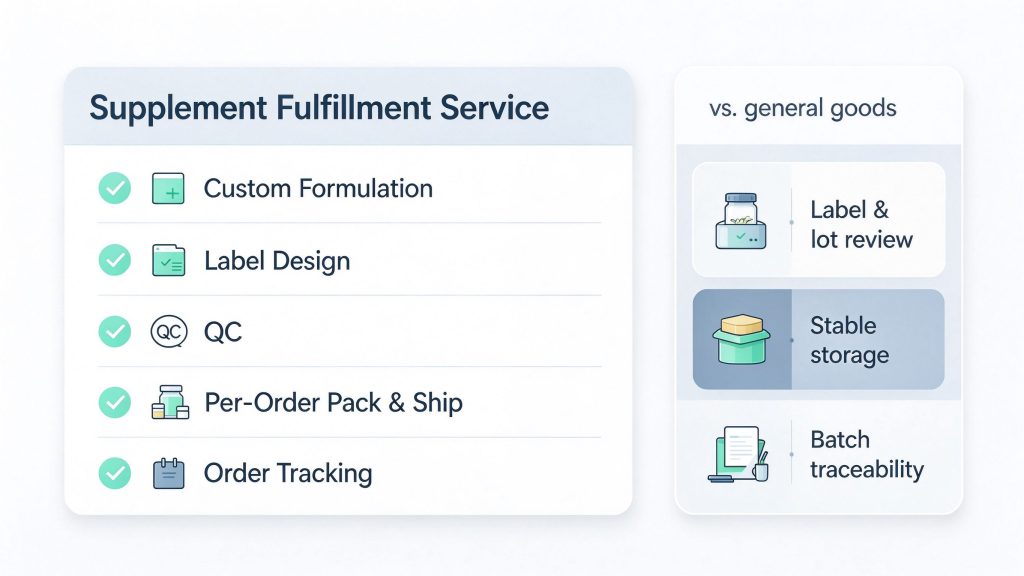
A complete shopify fulfillment service for health brands should describe its scope in writing rather than leaving the founder to infer what is included. The core checklist most successful partnerships publish covers five layers:
- Custom formulation. Options that match the brand’s positioning, target customer, and format — capsules, gummies, powders, softgels, or liquids — instead of forcing the store into whatever stock a warehouse happens to hold.
- Label design. Layout, claims organization, required information blocks, and the visual identity that keeps the product recognizable across SKUs.
- Quality control. Inspection before seal and before pack, including seal check, label check, unit condition, and lot or expiration review.
- Per-order pack and ship. Assembling the exact order, choosing protective packaging for the format, sealing the carton, applying the shipping label, and handing the parcel to the carrier.
- Order tracking. Automatic tracking numbers flowing back to the store, a visible status page for customers, and records that let the brand follow an exception when something goes wrong.
Each layer answers a different risk. Formulation controls what the brand sells; labeling controls how it is described; quality control protects the person consuming the product; pack-and-ship protects it in transit; tracking keeps the customer informed and the support team out of manual message chasing. When one of these layers is missing, the brand owner usually discovers it through a returned parcel, a confused customer, or a label dispute rather than through a clean operational report.
Scope also shapes launch speed. A partner that only stores and dispatches leaves the founder to source formulas, arrange label artwork, and negotiate packaging standards before the first order can move. A bundled service moves those tasks into a shared workflow, so the store can open with finished products rather than a half-built supply chain. For a new brand, that difference often decides whether the first campaign launches on schedule or waits for one vendor after another to deliver files, samples, and approval notes.
Why Health Product Fulfillment Is Not General Ecommerce Dispatch
Health product fulfillment operates under a different risk profile than apparel, accessories, or household goods. The buyer does not try the product and exchange it if it does not fit; they ingest it, apply it, or consume it over a routine, and any problem at the packing stage becomes a health-adjacent complaint rather than a return request. That difference changes what the operation must verify before a parcel leaves the building.
Labels carry required information that general goods do not: ingredient statements, supplement facts, lot codes, expiration dates, and manufacturer or packer identification. A warehouse that treats every box the same can mix labels across SKUs, miss an expired unit, or send a sealed sample out as a full-size order. Storage conditions also matter: some formats react to heat, moisture, or light, and a general storage room that works for folded shirts may not keep softgels stable through a warm carrier route. Lot-level records support a controlled recall when a batch ever needs attention, which is a capability a generalist provider often cannot describe beyond a vague inventory note.
| Concern | General goods handling | Specialized health operation |
|---|---|---|
| Label review at packing | Visual match to order, basic appearance check | Claims, facts panel, lot, and expiration reviewed per unit |
| Storage environment | Ambient space for most items | Stable conditions matched to format sensitivity |
| Traceability | Order record usually enough | Lot-level link between batch and shipped order |
| Returns | Inspect and restock or discard | Inspect seal, label, and unit condition before any restock decision |
| Error consequence | Wrong size or style, exchange request | Consumed product, complaint, and trust loss |
A specialized partner treats these checks as routine steps in the pick-and-pack sequence, not favors performed after a complaint arrives. The operating discipline is built into the workflow so that accuracy depends on the process rather than on the energy of whoever packed the latest parcel.
How Supplement Order Fulfillment Moves Stage by Stage
Supplement order fulfillment follows a chain that a founder can track and audit. Checkout completes in the store; the order transfers to the partner system through the store’s native connection; the requested SKU and variant are located against its batch record; a quality reviewer confirms the seal, label, and condition; the unit goes into format-appropriate protective packaging; the shipping label is applied; the carrier collects the parcel; and tracking data returns to the store and the customer.
At each handoff, the system should record what happened. The brand owner can then answer a customer’s “where is my order?” question without emailing a warehouse contact, and can identify whether a delay came from payment review, stock verification, packing, or carrier transit rather than guessing. Returns follow the reverse chain: a returned unit is logged, inspected for seal and condition, and either set aside or disposed of according to policy, with the outcome recorded against the original order so restocking decisions do not rely on memory.
For recurring customers on a subscription, the chain repeats on schedule with the same SKU, the same label standard, and the same batch discipline. A missed repeat or a substituted unit breaks the routine the customer paid to establish, which is why subscription accuracy belongs in the partner’s service description rather than in a special request list.
What a Standard Provider Usually Leaves Out
Many general dispatch providers list receiving, storage, pick, pack, and ship as their full scope, and stop there. That means the brand owner still needs to find a formulation source, a label designer, a quality reviewer, and a packaging partner, then coordinate handoffs between them. Each additional vendor introduces another timeline, another contact, another file format, and another point where a deadline can slip without the founder noticing until an order is late.
The missing layers matter most in the early stage of a health brand, when the owner has neither the network nor the staff to manage five separate relationships. A one-scope partner keeps formulation, design, review, and dispatch under the same operational standard, which shortens the launch path and reduces the number of documents the founder has to keep current. It also means that when a SKU changes, the label update, the quality checklist, and the packing standard update together, instead of one vendor changing weeks ahead of another.
There is also a hidden coordination cost to running separate vendors. A formula maker has no visibility into which SKU sold last week; a label designer does not know whether the warehouse can fit the artwork on the bottle; a packing team cannot explain a quality issue back to the source. The founder becomes the switchboard, forwarding files, chasing confirmations, and reconciling version numbers across inboxes. A bundled operation removes that switchboard role because every layer reads the same product record, the same label file, and the same order history.
Questions to Ask Before You Sign
Run a direct set of questions with every prospective partner. Ask what is included in the per-order price and what is billed separately; ask how labels and claims are reviewed before packing; ask how lot numbers and expiration dates are captured and checked; ask how subscription and bundle orders are assembled; ask how exceptions are reported and how often the founder receives operational summaries; and ask how returns are inspected and logged.
A partner that answers these questions with written procedures, sample screenshots of the tracking flow, and concrete examples of past checks is signaling that operations run on documented standards. A partner that answers only with promised speed and a low headline rate may not be ready for health products, where the cost of a missed check is higher than the cost of a slow reply.
The profit picture for per-order brands
Brands that keep production and dispatch per-order, with no bulk inventory sitting on shelves, typically keep gross margins in the 70–85% range after product and fulfillment costs, which leaves room for content, paid acquisition, and product expansion while keeping prices aligned with the customer’s budget. Because the cost structure scales with orders rather than fixed facilities, the brand does not lose pricing discipline during quiet periods and can reinvest when demand strengthens.
Frequently Asked Questions
What is included in a supplement fulfillment service?
A full-service provider covers formulation options, label design, quality control before shipment, per-order pack-and-ship work, and order tracking, with records linking each shipped unit to its batch and expiration data.
Can a general ecommerce warehouse handle supplements?
General warehouses can dispatch ordinary goods, but they usually lack the label review, batch and expiration discipline, storage conditions, and lot traceability that health products require. Those gaps tend to surface as returns, complaints, or compliance problems rather than as visible savings on the shipping invoice.
How are supplement returns handled?
Returns should be logged against the original order, inspected for seal, label, and unit condition, and dispositioned according to policy before any restock decision. Consumable products that have left the secure seal should not be returned to sale without a documented review.
How fast do supplement orders reach customers?
Specialized per-order partnerships commonly deliver in 6–10 days from checkout to doorstep, covering processing, quality review, packing, and transit. The brand should publish the partner’s demonstrated average rather than the fastest possible trip on a good day, and should keep the promise consistent across subscription orders and one-time purchases.
Conclusion
Comparing fulfillment services by headline shipping price misses the risk that matters most for health brands, which is why Shopify sellers often evaluate partners like NutFill on scope before comparing parcel rates. A shopify supplement fulfillment service that bundles formulation, label design, quality control, per-order dispatch, and tracking gives a founder one accountable operational partner instead of a chain of vendors to manage. NutFill operates that bundled model for Shopify sellers, with no minimum order quantity, delivery in 6–10 days, and a native app connection at https://apps.shopify.com/nutfill; founders launch on ready-to-brand formulas, validate customer demand, and later move to a proprietary product with the same partner, without switching suppliers along the way. Choosing scope and discipline first, then pricing, protects both the brand’s margin and the customer’s trust.
