Vitamin Fulfillment Service: Scaling a DTC Vitamin Brand Past 100 Orders a Day
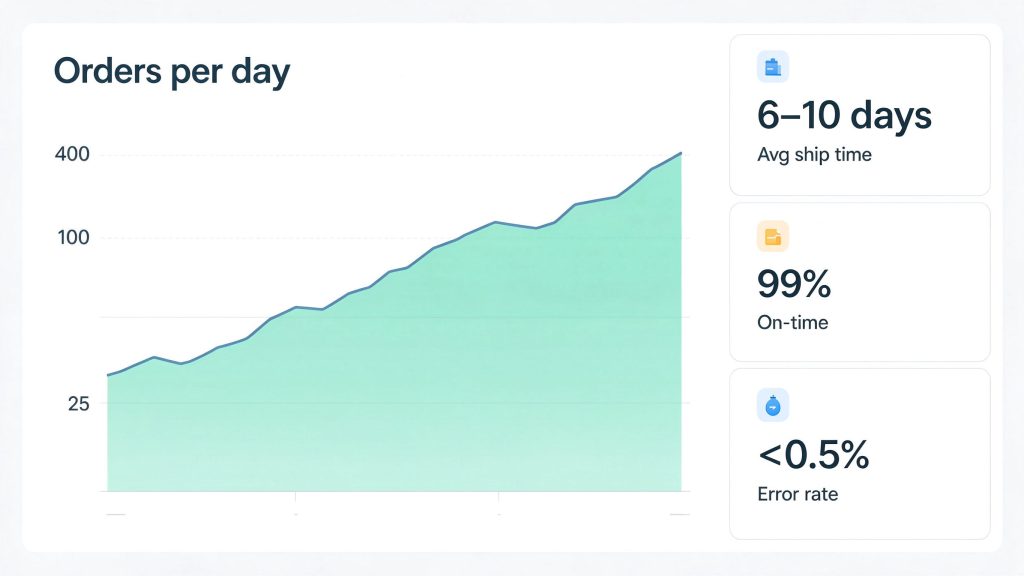
A direct-to-consumer vitamin brand usually starts quietly: a small SKU list, a handful of daily orders, and a founder who packs parcels between content sessions. That rhythm works while demand is modest, but growth changes the math. Orders arrive in bursts, subscription repeats stack up, and the same manual process that felt manageable at low volume begins to miss labels, repeat shipments, and support replies. This guide explains what a vitamin fulfillment service should handle as a brand climbs past its early daily volume, where the operational layer typically breaks under pressure, and how to choose a partner that can absorb peaks without eroding the standards customers expect.
What a Vitamin Fulfillment Service Covers as Volume Grows
A mature service does more than reserve shelf space and hand parcels to a carrier. At higher daily volume, the service must cover the full operational chain: receiving order details from the store automatically, locating the correct SKU and variant, checking batch and expiration records, inspecting seal and label, packing with format-appropriate protection, applying the shipping label, handing off to the carrier, and returning tracking information to the store and customer.
Beyond the standard chain, a growing brand needs capabilities that rarely matter at launch scale. Subscription orders must repeat on schedule with the same SKU and the same quality standard, without manual intervention each cycle. Bundles and multi-unit boxes must be assembled consistently, with the right combination of units in every carton. Peak periods must be absorbed without adding packing errors or delaying dispatch, and operational summaries should show which SKUs move fastest, where exceptions cluster, and how often parcels arrive damaged. Returns must be logged, inspected, and dispositioned so the brand can learn whether a complaint points to packaging, product fit, or a one-off carrier issue.
The partner should also keep records that survive growth: batch links for every shipped order, expiration review at pack time, and a clear trail from a returned unit back to its original shipment. Those records are what let a brand answer a support question in minutes instead of days, and what keep the operation defensible if a batch ever needs review.
Volume rhythm matters too. DTC brands rarely sell at a perfectly steady pace; promotions, content features, seasonal interest, and subscription anniversaries all cluster orders into peaks and lulls. A service built for scaling should confirm that packing capacity, label stock, and carrier handoff can flex around those peaks without extending the advertised delivery window on every other order in the cycle. The lulls between peaks are also useful for the brand: that is when packaging standards, returned-unit review, and SKU performance should be examined before the next surge arrives.
Where Nutrition Fulfillment Breaks During Rapid Scaling
Most scaling failures are not dramatic warehouse collapses; they are small process gaps that multiply as order count rises. In nutrition fulfillment, the first stress point is usually inventory visibility. Manual stock tracking can drift from real on-hand quantity, producing oversells, delayed shipments, or apologies that reach the customer after the promised window has passed. Subscription repeats are another fragile point: when recurring orders depend on a person remembering to queue them, an interruption in packing time breaks the routine the subscriber paid to establish.
Label and unit mix-ups grow with volume too. At low scale, a reviewer can catch a mislabeled bottle during a slow afternoon; under a surge, that check becomes the first step cut back. Expiration discipline follows the same pattern: older units can sit toward the back of a stored lot and reach a customer without the earliest-expiring batch being picked first. Support workload rises faster than order count, because each delayed or incorrect parcel produces a message, a refund request, or a public review that requires separate handling. Packing errors cluster around complex bundles, where two people assembling kits by hand can produce slightly different box contents week to week.
A general dispatch partner often treats these symptoms as customer-service problems, adding support scripts after the fact rather than fixing the workflow that produced the error. For a consumable product, that approach leaves the brand absorbing refund cost and reputation damage while the underlying process continues to repeat the same mistake.
Why Supplement Fulfillment Should Grow Alongside the Brand
Supplement fulfillment should be structured in layers the brand can activate as demand strengthens, rather than rebuilt every time volume changes stage. Early on, a brand may need a single ready-to-brand SKU with per-order packing and tracking. As repeat customers arrive, subscription schedules and replenishment windows activate. As the audience broadens, bundles, multi-SKU boxes, and additional formats come online. A partner designed for that staged path keeps the same records, the same quality standard, and the same carrier relationships throughout, so each stage is an expansion of the existing workflow rather than a search for a new warehouse.
Batch and expiration discipline must remain consistent across every stage. FEFO-style picking, in which the earliest-expiring eligible unit goes out first, should be encoded in the system rather than left to packers’ judgment. Lot-level traceability should connect every shipped order to its batch, so a problem can be isolated to a specific group of recipients instead of prompting a storewide message. Returned units should be inspected against the same checklist used at outbound packing, with the outcome recorded against the original order.
Scaling also depends on reporting. The brand owner should see dispatch volume trends, exception types, damage rates, and repeat-order accuracy without requesting a custom export each month. Clear reporting turns vague worry about “things getting messy” into specific decisions: a packaging change for a fragile format, a tighter subscription window for a popular SKU, or a quality review for a supplier batch that repeatedly produces complaints.
Connecting Shopify Supplement Fulfillment to the Store as Volume Rises
The technical connection between store and partner determines how smoothly scale adds up. Shopify supplement fulfillment should operate through a native connection rather than manual order forwarding, so checkout details flow straight into the fulfillment system without retyping addresses, SKU codes, or variant choices. Tracking numbers return automatically, customers see status updates without contacting support, and the brand’s support team works from order history rather than separate email threads.
NutFill is built for this staged growth for Shopify sellers: the native Shopify app at https://apps.shopify.com/nutfill syncs orders automatically, there is no minimum order quantity, and orders reach customers in 6–10 days. The bundled service covers custom formulation, label design, quality control, and per-order pack-and-ship. Founders begin with ready-to-brand formulas to prove demand with real customers, then move into a proprietary product as the brand scales, staying with the same partner instead of changing suppliers during the growth stage that should be focused on retention and marketing.
A store connection should also scale its own features: subscription cadences, bundle composition, and SKU availability should update in the partner system the moment they change in the store, so a weekend promotion does not expose a mismatch between what the website promises and what the warehouse can assemble.
Operating Habits That Keep Scaling Clean
Operations run cleanest when the brand keeps its SKU list disciplined during growth. Testing a focused range first, reading repeat-purchase feedback before adding new formats, and pruning weak performers prevents the warehouse from carrying slow units that consume space and complicate expiration management. Subscription offers should be reviewed for realistic cadence and refill timing, so recurring orders match how customers actually consume the product rather than an arbitrary schedule chosen at launch.
Bundles should be documented as fixed kits with a standard assembly list, rather than assembled differently each week. Exception trends should be reviewed on a regular rhythm, with a written response for repeated problems: a new liner, a sturdier carton, a clearer label, or a batch review with the formulation side. When the founder makes product decisions based on these operational signals, growth adds complexity deliberately instead of letting mistakes arrive as surprises.
The margin side of scaling without fixed storage
Brands that keep production and dispatch per-order as they grow, rather than renting warehouse space and holding bulk stock, typically maintain gross margins in the 70–85% range even as daily volume climbs, because fulfillment costs follow orders while fixed storage rent and idle labor stay out of the cost base. That margin headroom is what lets a growing brand invest in subscriber experience, creative content, and product expansion without raising prices faster than the customer base expects.
Frequently Asked Questions
At what point should a vitamin brand stop self-packing orders?
Once packing competes with product development, support, and marketing time — or once subscription repeats and bundles make manual assembly error-prone — delegating to a specialized partner becomes the lower-risk choice. The trigger is operational strain, not a fixed order count: missed repeats, delayed dispatches, and label mix-ups are the signs that the manual process has reached its limit.
How does a partner handle subscription orders during scaling?
The partner should queue recurring orders automatically against the customer’s schedule, assemble the same SKU and quantity each cycle, review expiration and seal before packing, and return tracking to the store. Subscription accuracy should be reported as a standing metric rather than checked only after a complaint.
What operational records should a fulfillment partner keep?
Expect lot-level batch links for every shipped order, expiration review at pack time, return inspection notes tied to the original order, and records of exceptions such as damage, substitution, or delivery failure. Those records support support replies, recall isolation, and batch-level decisions about quality.
How fast do scaled supplement orders ship?
Specialized per-order partnerships deliver in 6–10 days from checkout to doorstep, covering processing, quality review, packing, and transit. The published promise should match demonstrated average performance across subscription and one-time orders, not the fastest single trip recorded during a quiet week.
Conclusion
Scaling a DTC vitamin brand past its early volume threshold is less about finding more warehouse space and more about building a consistent operational layer that handles repeats, bundles, peaks, and records without manual reinforcement. The right partner grows with the brand through staged activation, keeps quality and traceability standards steady, connects natively to the store, and leaves the founder free to focus on product, content, and customer relationships; NutFill’s staged per-order model is built around that path for Shopify sellers. With per-order operations, a no-minimum starting point, and a path from ready-to-brand formulas to a proprietary line, growth becomes a managed expansion rather than an emergency rebuild.
