Supplement Order Fulfillment: From Click to Doorstep in 5 Steps
A customer who buys a supplement rarely sees the operation behind the parcel. They experience a checkout page, a confirmation message, a tracking link, and a delivery at the door — and judge the brand on whether the right product arrives sealed, intact, and on time. Behind that simple experience sits a sequence of checks, handoffs, and records that decide whether the order becomes a repeat purchase or a complaint. This guide walks through the fulfillment journey from checkout to doorstep, explains where quality stays consistent between shipments, looks at the usual delay points and how they are prevented, and describes what a connected store experience means for the customer on the other end.
The Supplement Order Fulfillment Journey, Stage by Stage
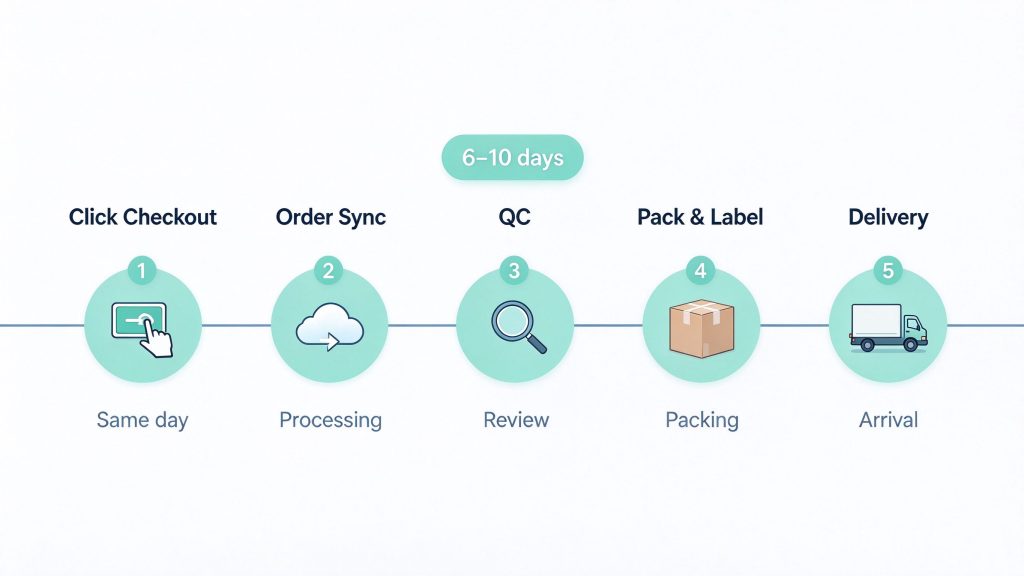
Supplement order fulfillment follows a sequence customers never see, but which should be traceable end to end.
- Click checkout. The customer selects a product, confirms the variant, and completes payment. The store records the SKU, quantity, shipping address, and any bundle or subscription choice. A clear confirmation message sets the expectation for when the order will be processed and delivered.
- Order sync. The order transfers automatically into the fulfillment system through the store’s native connection. Details are matched against live product availability, lot records, and subscription cadences so that the packing stage receives a clean, complete request rather than a manually entered note.
- Quality check. The requested unit is located and reviewed before packing. The reviewer confirms the correct SKU and variant, checks the lot and expiration record, verifies the seal and label, and inspects the unit for visible damage or defects. A unit that fails this check does not move forward; it is held for review against the batch record.
- Pack and label. The approved unit goes into protective packaging matched to its format — cushioning for glass, sealed liners for powders, firm cartons for multi-unit bundles — then the shipping label is applied and the parcel enters the carrier queue.
- Delivery. The carrier collects the parcel, scans it through its network, and delivers it to the address on file. Tracking events flow back into the store so the customer can follow movement from dispatch to arrival.
Across these stages, a well-run operation completes processing, quality review, packing, and dispatch within a reliable rhythm, with transit bringing the total experience to 6–10 days from checkout to doorstep. Each stage has a record attached: what was ordered, which batch was picked, who checked it, how it was packed, and when tracking activated. That trail is what turns a vague support question into a specific answer.
How Nutrition Fulfillment Keeps Quality Consistent Between Orders
Nutrition fulfillment succeeds when every parcel meets the same standard, whether it is the first order of the week or the hundredth. Consistency starts at the label: the correct product name, facts panel, batch code, and expiration date must match the order every time, because a mismatched label on a consumable product creates a safety-adjacent concern, not just a packaging error. The packer should never substitute a similar unit from nearby stock without a recorded approval.
Seal and unit condition are checked against the same checklist on every outbound parcel. Capsules should be settled but intact, bottles closed and sealed, powders inside sealed liners, and softgels free of melting or sticking signs that suggest exposure to heat during storage or transit. Packaging standards should also stay uniform: the same carton strength, the same cushioning materials, the same label placement, so a fragile format arrives in the same condition regardless of who packed it.
Expiration discipline runs throughout the cycle. The earliest-expiring eligible unit for a given SKU is picked first, and short-dated stock is held out of new outbound orders rather than shipped to a customer who expects a full usable shelf life. Records link each shipped parcel to its batch, so if a quality question surfaces later, the brand can identify the affected group instead of guessing which recipients received which unit.
Why Supplement Fulfillment Delays Happen—and How They Are Prevented
Supplement fulfillment delays rarely come from one dramatic failure; they usually accumulate from small friction points along the chain. Payment review can hold an order while a fraud or address check completes, and an order held for review should move into packing only after that check clears. Stock mismatch occurs when stored quantity drifts from the system record, causing a promised SKU to be unavailable at packing time. Carrier congestion, weather, and seasonal volume can stretch transit times after the parcel leaves the warehouse, while a damaged or returned unit may need replacement before the customer’s expectation can be met.
Prevention depends on process rather than urgency. Native order sync keeps availability and order details aligned at checkout, so the store does not promise a SKU the warehouse cannot assemble. Batch and expiration records are checked at the packing stage rather than during a complaint review afterward. Exceptions are logged the moment they occur, with an owner and a resolution note, so a delayed replacement does not wait until the customer asks where the parcel is. Carrier arrangements should reflect the destination market and the format being shipped, so fragile or heat-sensitive units are not routed through a service known for rough handling or long layovers.
Proactive communication also removes a large share of delay frustration. When an order is held for review, a customer notice sets the right expectation; when transit runs long after dispatch, an updated tracking page and a short support reply prevent the customer from assuming the parcel was lost. The brand that communicates early looks responsive even when the parcel itself is late; the brand that stays silent looks disorganized regardless of the actual cause.
What Shopify Order Fulfillment Integration Means for the Customer Experience
Shopify order fulfillment that runs on a native store connection gives the customer an experience that feels continuous across the whole journey. Order details flow without manual reentry, which reduces address and variant mistakes before packing ever begins. Tracking activates automatically after dispatch, and status updates appear in the customer’s account or email flow rather than requiring support to look up each parcel individually. Support agents work from the same order record, so a question about a repeat subscription, a bundle component, or a tracking delay can be answered without a separate investigation thread.
NutFill operates this connected model for Shopify sellers through its native app at https://apps.shopify.com/nutfill, with no minimum order quantity and delivery in 6–10 days. The bundled workflow covers custom formulation, label design, quality control, and per-order pack-and-ship, and the tracking record carries through every stage. Founders launch with ready-to-brand formulas, validate demand through real orders, and later move into a proprietary product while remaining with the same partner, so the customer experience stays consistent as the brand evolves.
A connected system also handles subscription changes without a manual handoff: cadence updates, skipped cycles, and bundle composition changes register in the fulfillment record the same way they appear on the storefront. That alignment is what keeps a recurring customer confident that the next refill matches what they chose, rather than hoping a packed order matches the website after the fact.
What Customers Notice When the Operation Runs Well
Most quality signals a customer notices are unglamorous: the right product in the right format, an intact seal, a clean readable label, packaging that has done its job during transit, and a tracking page that shows real movement. When those basics hold, the customer focuses on the product experience rather than the delivery experience, and repeat purchases become a natural outcome of trust rather than a sales push. Conversely, a late or damaged parcel occupies the customer’s attention for weeks, even when the product itself is excellent, because delivery failure is attached to the brand name on the box.
The operation behind a health brand should therefore be evaluated as part of the product itself. A reliable journey from click to doorstep protects the routine a customer is building with a daily supplement, and it keeps the brand free to spend its creative effort on formulation and content rather than damage control over parcels that should have been handled correctly the first time.
The margin side of per-order operations
Brands that keep production and dispatch per-order, without holding bulk stock across multiple locations, typically maintain gross margins in the 70–85% range as they grow, because fulfillment costs scale with orders rather than fixed storage and standing packing labor. That margin headroom supports faster support replies, better protective packaging, and subscription flexibility without forcing the brand to pass every operational cost straight into the customer’s price.
Frequently Asked Questions
What happens between checkout and dispatch?
The order syncs automatically to the fulfillment system, the requested SKU is located against its batch record, the unit passes seal, label, and condition review, then it is packed with format-appropriate protection and labeled for carrier handoff. Records attach to the order at each stage so support can trace what happened.
How long does a supplement order take to arrive?
Specialized per-order partnerships deliver in 6–10 days from checkout to doorstep, covering processing, quality review, packing, and transit. The advertised window should reflect demonstrated average performance across destinations rather than the fastest single delivery.
Why did my supplement order arrive late?
Common causes include payment or address review holds, stock availability issues discovered at packing, carrier congestion or weather during transit, and replacement of a returned or damaged unit. A transparent fulfillment partner logs each exception and updates tracking or notifies the customer when the delay originates outside normal dispatch timing.
How are subscription refill orders checked before shipping?
Subscription orders follow the same quality checklist as one-time orders: correct SKU and variant, batch and expiration review, seal and label inspection, protective packing, and tracking activation, with the cadence change reflected in the fulfillment record when the customer adjusts their schedule.
Conclusion
From click to doorstep, the supplement journey is a chain of small checks that add up to trust. A clear five-stage flow, consistent quality standards, logged exceptions, and a native store connection — the connected workflow NutFill operates for Shopify sellers — keep operations reliable as order volume grows, while the customer experiences only a smooth, well-communicated delivery. For a health brand, that reliability is part of the product: it protects the daily routine customers rely on and turns a single purchase into a lasting relationship.
