Shopify Supplement Supplier: What 6–10 Day Shipping Really Requires
A delivery window is the easiest claim to make and the hardest one to keep. A store owner can write a fast shipping promise on a product page in minutes, but holding that promise order after order depends on a partner’s pack line, stock discipline, quality checks, and carrier coordination behind the scenes. This guide looks past the advertised number: what a shopify supplement supplier must run inside its operation to deliver parcels to customers in 6–10 days, what operations and compliance capabilities that demands, and how a store should judge whether a supplier’s promise is built on a real pipeline or on optimism.
Why a shopify supplement supplier cannot promise fast delivery by itself
Shipping speed is a shared outcome, not a single department. The supplier controls preparation and packing, but the carrier controls the route, sorting, and final mile; the store controls expectations set on the product page and in confirmation messages. The honest promise describes the whole pipeline from order receipt to doorstep, not the hours the parcel sits on the pack line alone.
Suppliers that advertise a quick window without describing their pipeline usually fail at exactly the moments a store can least afford: order spikes, stock gaps, quality holds, or carrier delays. A founder evaluating a partner should ask what happens at each stage before dispatch, how stock is tracked, where quality checks sit, and how delays are reported. If those answers are vague, the delivery window on the product page is a marketing claim rather than an operational commitment.
The store’s own behavior also affects the timeline. Accurate listing availability, honest claim language, and confirmation messages that match the partner’s actual window reduce the expectation gap. Customers who know when to wait are more forgiving than shoppers promised a speedier arrival who then watch tracking stall. Fast delivery works best when supplier, store, and carrier are all operating from the same realistic schedule.
The pipeline a shopify supplements supplier must run before dispatch
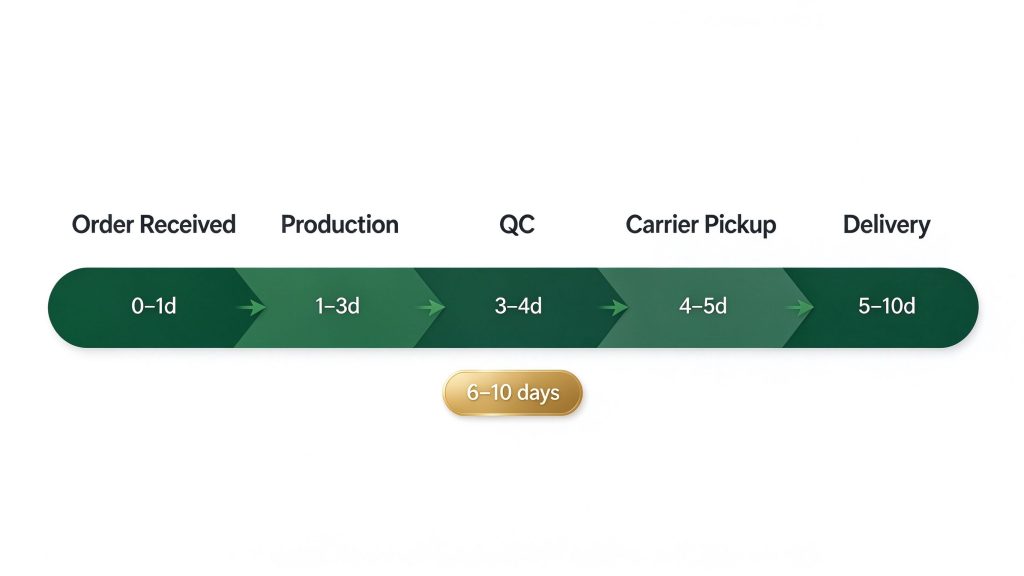
A dependable partner runs a visible, repeatable pipeline before any parcel enters the carrier network. Each stage feeds the next, and a bottleneck at one stage pushes the whole window out.
The first stage is order receipt. The store order arrives through the connection between Shopify and the partner’s system, registers correctly, and queues in the packing workflow. Manual entry steps are the most common source of missing or duplicated orders, so a direct store connection is what keeps this stage clean.
The second stage is preparation or production. For ready-to-brand formulas, the partner retrieves the correct product and label; for custom formulations, preparation follows the agreed blend and packaging plan. Stock levels for each catalog item are known before an order reaches the queue, and an unavailable product triggers an early notification rather than a silent delay.
The third stage is quality control. Before sealing, the parcel is checked against the order: correct formula, correct quantity, readable label, intact seal, and clean supplement facts panel. Batch records are kept for reference, and anything that fails the check does not move to dispatch.
The fourth stage is carrier pickup. The sealed parcel moves to the outbound area, receives tracking, and hands off to the carrier on a regular schedule. A partner that waits for parcel accumulation or irregular pickup times extends the timeline even when packing itself was fast.
The fifth stage is delivery. Once in the carrier network, the parcel travels through sorting to the customer’s address, and tracking updates should remain visible through arrival. The partner’s responsibility ends after a clean handoff, but the store should choose a partner whose carriers and delivery zones match its main customer base.
Across these stages, a realistic total window of 6–10 days reflects preparation, checks, handoff, and transit together, rather than a fastest-case transit number advertised on its own.
What a shopify nutrition supplier needs on the operations side
This kind of supplier runs a business that mixes physical production, packaging, and order processing, so operational maturity matters as much as formula variety. The pack line should be organized by individual order rather than by bulk shipment: each parcel assembled, checked, sealed, and logged on its own. Pre-bagged generic stock cannot support a genuinely branded experience, and it also complicates quality review when a customer question arrives.
Stock discipline is the next operational requirement. Catalog formulas should have internal availability records, and out-of-stock status should reach the store before the listing continues taking orders. Promotion planning depends on knowing which formulas can run a campaign without selling out halfway. Volume handling matters as well: the same per-order quality should hold on a quiet day and on a busy promotion day, without queues collapsing into missed orders.
Packaging accuracy belongs in the same operational layer. The right bottle, pouch, or jar reaches the right order, the seal closes cleanly, and the label sits straight and readable on arrival. Softgels and capsules need protection against crushing, powders need a dry and sealed interior, and liquid formats need packaging that survives sorting without leakage. A pack line that treats these details as routine keeps parcel quality consistent across the whole customer base, rather than getting it right on the first few orders and slipping under volume pressure.
Documentation and record keeping belong inside the operation, not in a separate afterthought system. Batch numbers, quality checks, formula records, and label copies should be traceable to individual orders. That record structure protects the brand when a customer asks about an ingredient, a platform review raises a question, or a compliance review needs supporting material. NutFill keeps batch records and quality checks tied to each packed order, so the store can answer ingredient questions with documentation rather than guesswork.
What a shopify health products supplier must keep compliant and transparent
This supplier sells into a category where labeling and claim language carry real responsibility. The supplement facts panel should match the formula inside the parcel, the ingredient list should be complete, and the brand name and benefit statement should appear clearly. Claim language should describe general wellness support rather than treatment, cure, or prevention of disease, and the store should treat that boundary as a standing rule for every product page and label.
Transparency means the partner can explain what documentation it holds and how labeling is reviewed before publishing. A supplier that cannot answer where batch records live, how panels are checked, or how claims are screened leaves the brand to carry risk alone. The store owner remains accountable to customers and platforms for what appears under its own brand, so choosing a partner with honest internal review is not optional.
Communication transparency matters alongside compliance. Stock changes, lead-time shifts, and order issues should be reported in plain language through a clear channel, with enough lead time for the founder to adjust listings or answer support. Suppressing problems until a customer complains turns an operational issue into a review crisis.
How a partner holds a steady delivery window over time
A delivery window proves itself over repeated orders, not on a first shipment. Steady performance requires internal standards: regular queue processing, scheduled carrier handoffs, consistent packing quality, and honest reporting when something falls outside the norm. Partners that hold their window keep the workflow simple, avoid hidden manual steps, and review delays after they happen rather than repeating the same bottleneck silently.
For a founder, the best test period is the early launch phase: watch order receipt speed, packing timing, tracking availability, customer delivery feedback, and support questions about shipments. This early data shows whether the partner’s advertised window matches ordinary-day reality. If the first orders arrive within the stated window with clean parcels and readable labels, the store can plan promotions around that baseline; if timing drifts early, it usually drifts more under ad pressure.
NutFill runs this pipeline as one integrated service. The native Shopify app (https://apps.shopify.com/nutfill) connects orders directly to the fulfillment flow, and the same team handles custom formulation, label design, quality control, and per-order pack-and-ship, with deliveries reaching customers in 6–10 days. There is no minimum order quantity, so a new store tests the pipeline on real orders before scaling promotion behind it. When a product proves itself, the same partner moves the brand toward a proprietary product rather than forcing a supplier change after launch.
Frequently Asked Questions
What makes delivery promises hard to keep?
Fast delivery depends on order flow, preparation, quality checks, carrier handoff, and transit working together. A weak point at any stage delays the whole parcel, and a promise written without describing the internal pipeline usually fails under ordinary order volume.
Why does a direct Shopify connection matter for delivery timing?
A direct app connection sends orders into the fulfillment workflow without manual transfer, which prevents missed orders, duplicates, and late handoffs. Those entry errors are among the most common causes of delayed parcels and support tickets.
What quality check should a supplier perform before dispatch?
Each parcel should be checked for the correct formula, quantity, intact seal, readable label, and an accurate supplement facts panel, with batch records kept for later reference. Orders that fail the check should not be sealed and handed to the carrier.
How should a store evaluate a partner’s delivery window in real life?
Watch the first launch orders for receipt speed, packing timing, tracking updates, and customer feedback on arrival. A steady baseline on ordinary days matters more than one fast sample shipment, because campaigns bring more volume rather than less.
What compliance responsibilities stay with the brand?
The brand remains accountable for its labels, claim language, and product information even when a partner packs the parcel. Supplement facts should be accurate, claims should stay within general wellness framing, and the store should choose a partner that keeps documentation organized and reviewable.
Six-to-ten-day delivery is a pipeline promise, not a headline. The partner earns a dependable window through clean order receipt, organized preparation, visible quality control, scheduled carrier handoff, and transparent reporting when things go wrong. The founder’s job is to evaluate that pipeline in writing, test it on early orders, and keep compliance and communication standards high as volume grows. When supplier and store operate on the same honest timeline, the delivery promise protects reviews, repeat purchases, and paid traffic rather than becoming the source of complaints that undermine the brand.
