Private Label Supplements Manufacturer vs. Platform: Which Route Fits You?
Founders planning a supplement brand usually arrive at one of two routes: go straight to a manufacturing partner that produces custom products in batches, or work with a fulfillment platform that stocks ready-to-brand formulas, labels them under the brand, and ships per order. A direct manufacturer offers depth and formula control for established brands, while a white label supplement supplier or fulfillment platform offers speed and low commitment for new ones; neither route is universally better, and the right choice depends on the brand’s stage, evidence, cash position, and need for control. This guide compares the two objectively, outlines what each route handles, which stage each suits, and how a private label supplement platform fits a brand that wants to launch fast and evolve later without switching partners.
Two Routes to a Branded Supplement Product
Both routes end with a branded bottle in a customer’s hands, but the work, commitment, and control differ before that point.
- Direct manufacturer route: the brand contracts with a production facility to develop or produce its own formula, usually in defined batch sizes, with the brand managing labeling, packaging, storage, and fulfillment around the production run.
- Fulfillment platform route: the brand chooses from an existing catalog of formulated products, applies its own label, and the platform handles quality control, per-order packing, and shipping to customers, with optional custom development later for proven products.
The comparison below stays neutral: each route has strengths at a different stage, and choosing the wrong route for the current stage is what usually creates the friction — high upfront cost, slow launch, fragmented vendors, or a lack of control when the brand needs it.
The Direct Private Label Supplements Manufacturer Route
A direct manufacturer is a production facility that makes supplement products in batches. It focuses on formulation, production capacity, batch records, and quality systems, and it typically expects the brand to commit to a meaningful order size per formula.
What this route offers:
- Formula control. The brand can define ingredients, blends, flavors, and dosage ranges around its own concept, subject to the manufacturer’s production capabilities and compliance review.
- Product exclusivity. A custom blend produced for this brand alone cannot be listed by another brand under a shared catalog, which supports differentiation once the brand has an audience.
- Production depth. Manufacturers can support larger volume runs, specific format development, and broader product lines as a brand scales.
- Direct quality relationship. The brand works directly with the production team on ingredient identity, batch consistency, and documentation.
What this route requires:
- Batch commitments. Production runs are ordered in defined quantities, so the brand ties up cash in inventory before knowing whether the formula sells.
- Coordinated vendors. Label design, packaging sourcing, warehousing, order packing, and shipping are often handled outside the manufacturer, which means the brand or its team coordinates several suppliers.
- Longer setup. Formula development, testing, sample approval, label review, and production scheduling take time before the first customer can order.
- Compliance ownership. The brand carries more responsibility for label accuracy, claims review, ingredient documentation, and storage practices across the vendors it coordinates.
This route fits a brand that already has demand evidence, a defined audience, cash for inventory, and a product concept strong enough to justify custom development. It is a later-stage tool, not a launch shortcut.
The Private Label Supplement Platform Route
A fulfillment platform combines catalog products, branding support, quality control, and per-order fulfillment in one service. The brand selects ready-to-brand formulas, applies its own identity, and the platform stocks, labels, packs, and ships each order as it arrives.
What this route offers:
- No inventory commitment. The brand does not buy bulk stock, so cash stays free while demand is tested, and products can be added or retired based on real orders.
- Fast launch. Existing formulas with structured panels and documentation let the brand design a label, build a storefront, and start selling without waiting on production scheduling.
- Integrated fulfillment. Packing, shipping, tracking, and quality control sit in the same workflow as the catalog, reducing the number of vendors the founder must manage.
- Shopify-ready connections. A native storefront app sends orders to the pack line automatically and passes tracking back to the customer, which matters for brands operating online from day one.
- A path to custom products. Many platforms support custom formulation later, so a proven winner can move into a proprietary product without leaving the partner relationship.
What this route gives up:
- Shared formulas. Catalog products are also available to other brands, so early differentiation comes from positioning, audience, creative, and service rather than a unique blend.
- Higher per-unit cost. Per-order fulfillment usually costs more per unit than large batch production, which is the price of zero inventory risk at the testing stage.
- Less early formula control. The brand chooses from the catalog until it reaches the stage where custom development makes sense.
A branded wellness line launched through this route can reach the 70–85% gross margin range once the brand controls pricing, positioning, and customer experience; that margin funds creative work, retention tools, and the eventual move to custom products.
Comparing the Two Side by Side
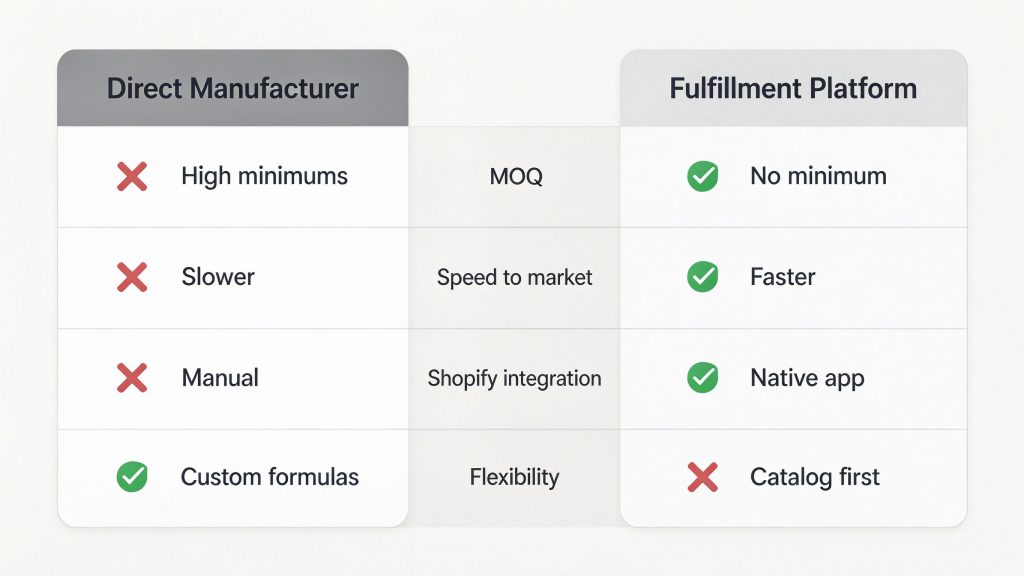
The table below summarizes the main differences without judging which is superior:
| Dimension | Direct Manufacturer | Fulfillment Platform |
|---|---|---|
| Minimum order commitment | High batch quantities required | No minimum order quantity |
| Speed to market | Longer: development, samples, production scheduling | Faster: catalog products ready to brand |
| Shopify integration | Usually manual or arranged separately | Native app or clean storefront connection |
| Formula flexibility | High: custom blends and formats from the start | Catalog first; custom options after validation |
| Vendor coordination | Brand coordinates production, labels, warehouse, shipping | One partner handles catalog, QC, packing, shipping |
| Inventory risk | Brand holds produced stock | Partner holds stock; brand pays per order |
| Best stage | Proven brand with demand evidence and cash for inventory | New brand testing demand and building an audience |
Beyond the table, the operational burden differs in practice. A manufacturer route asks the brand’s team to manage purchasing, packaging procurement, warehouse receiving, label artwork files, order picking, and courier accounts, even when the factory itself is reliable. A platform route absorbs those tasks into the per-order service, which leaves a small team free to focus on audience, creative, and customer experience instead of fulfillment logistics.
Which Stage Fits Which Private Label Supplement Supplier
A supplier should be chosen against where the brand actually is, not where it hopes to be in a year.
Launch and validation stage: A platform route fits a founder with an audience but no sales history, limited cash for inventory, and a need to learn what buyers want. The platform keeps upfront commitment small, launches fast, and collects real feedback before any custom development decision.
Growth and validation stage: Once a catalog product earns repeat purchases, clear reviews, and steady orders, the brand can evaluate custom options. The ideal platform supports this transition internally, keeping documentation, label files, quality standards, and fulfillment practices continuous.
Scaled brand stage: A direct manufacturer route becomes relevant when the brand has volume, predictable demand, a need for exclusive formulas, and the operational capacity to coordinate production, packaging, warehousing, and fulfillment across vendors. At that stage, batch production can reduce per-unit cost and support a larger catalog.
The two routes are not mutually exclusive across a brand’s life. Many successful brands start on a platform to validate, move winners toward custom development with the same partner, and consider direct manufacturing only when volume and operational maturity justify the coordination overhead.
NutFill sits on the platform side of this comparison: there is no minimum order quantity, the native Shopify app connects the storefront directly (https://apps.shopify.com/nutfill), and shipped orders typically arrive in 6–10 days. The service combines custom formulation, label design, quality control, and per-order pack-and-ship under one roof, so a brand launches with ready-to-brand formulas, validates demand through real orders, and moves into proprietary products with the same partner rather than rebuilding supplier relationships, label files, and quality records after growth. For founders who want one accountable team across launch and later customization, that continuity is the main reason to choose the platform route from the start.
Frequently Asked Questions
Should a new supplement brand start with a manufacturer or a platform?
A new brand without sales history usually starts with a platform, because it tests demand without bulk inventory, launches faster, and keeps the founder focused on audience and messaging. A direct manufacturer becomes a stronger fit after the brand has proven repeat purchases, predictable volume, and a product concept worth developing exclusively.
Can a platform produce custom formulas later?
Many platforms support custom formulation for proven products, which lets the brand keep the same documentation, quality standards, label workflow, and fulfillment relationship when it moves from shared catalog products to proprietary blends. Confirm this capability with the partner before launch if custom development is a long-term goal.
Why do direct manufacturers require minimum order quantities?
Production facilities run in batches to keep equipment, ingredient sourcing, and quality systems efficient, so they expect defined order sizes per formula. That model suits brands with established demand; for early testing, the batch commitment means tying cash to inventory before buyers have spoken.
Does a platform offer less product quality than a manufacturer?
Quality depends on the specific partner’s systems, documentation, storage practices, and batch controls, not on the route label itself. A responsible platform maintains quality standards, provides analysis certificates, and stores products properly, while a manufacturer varies in the same way. Review documentation and inspect samples before choosing either route.
When is it worth switching from a platform to a direct manufacturer?
The switch becomes worth considering when the brand has steady volume, exclusive formulas, and the operations to coordinate production, packaging, warehousing, and shipping separately. Until then, the platform’s integrated service usually costs less in management time and inventory risk than the savings from batch production.
Closing Thoughts
The manufacturer-versus-platform choice is really a stage choice: direct manufacturing offers control and depth for proven brands with volume and cash, while a fulfillment platform offers speed, low commitment, and integrated service for brands still learning what their audience buys. The strongest long-term path often starts on a platform, validates winners, and moves into custom products with the same partner, so the brand grows without restarting supplier relationships. Match the route to the evidence you have today, and revisit the decision once real orders tell you which stage you are actually in.
