Shopify Order Fulfillment: Returns, Exchanges, and Expired Products Handled Right
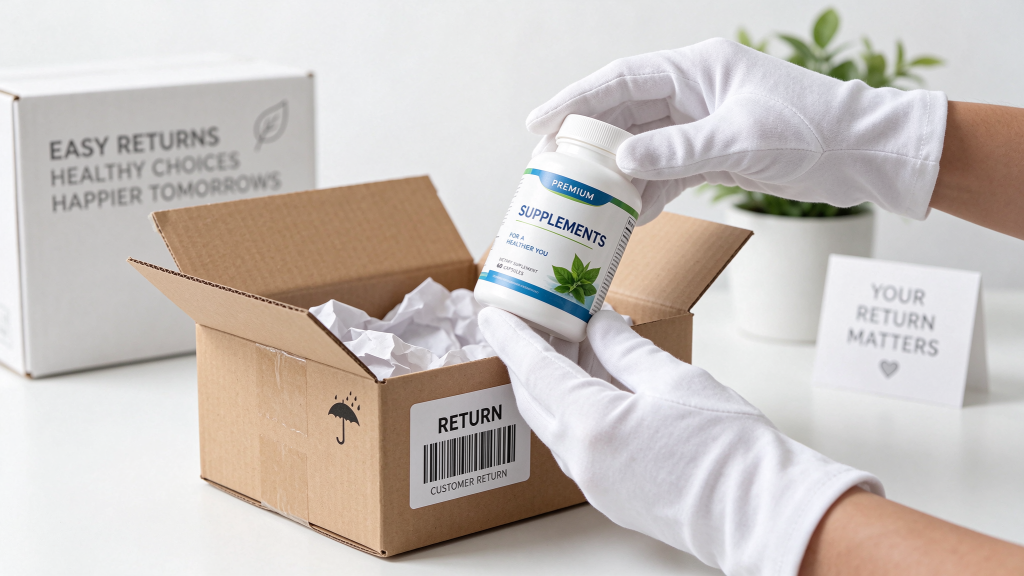
Returns are the part of Shopify order fulfillment nobody wants to think about — until a customer emails at 11 p.m. asking for a refund on an opened bottle of magnesium. For supplement brands, returns are messier than in almost any other e-commerce category. You can’t restock an opened bottle. Expiration dates create liability. Damaged bottles leak. And if your policy is unclear, your support inbox becomes a full-time job. This post walks through how to set up returns, exchanges, expired-product handling, and damaged-in-transit workflows so that the rare return feels like a clean, professional process instead of a fire drill.
The First Rule: You Cannot Resell an Opened Supplement Bottle
This is the line every supplement brand must internalize immediately. Once a customer has opened a bottle — even if they’ve taken zero capsules — that product cannot go back into your sellable inventory. There is no “lightly used” in consumable health products. Health regulations, customer trust, and basic common sense all point the same way: opened bottles are written off, not restocked.
This single fact shapes your entire returns policy. It means you cannot offer free return shipping on opened bottles and expect to make money. It means every opened-bottle refund is a total loss of COGS. And it means your policy needs to be clearly worded so customers know what to expect before they buy.
The standard approach in the supplement industry is a hybrid: unopened, resalable bottles can be returned for a refund within a defined window (typically 14–30 days); opened bottles are usually refunded at the brand’s discretion, often without requiring the bottle to be shipped back — because paying return shipping on a bottle you’re going to throw away costs more than the product itself.
Writing a Returns Policy That Protects You and the Customer
A good returns policy does two things at once: it sets clear expectations so customers aren’t surprised, and it gives you a defensible position when disputes arise. Yours should cover:
- Return window: e.g., “14 days from delivery for unopened products.”
- Condition requirements: “Product must be unopened, in original packaging, and in resalable condition.”
- Opened-bottle policy: “We’re confident you’ll love our products. If you’ve opened a bottle and aren’t satisfied, contact our support team — we’ll make it right.” This is where you absorb the cost on a case-by-case basis rather than promising free returns on every opened bottle.
- Restocking fees: Many supplement brands charge a 15–20% restocking fee on returned unopened items to cover processing and return shipping. This is legal and standard; just disclose it up front.
- Return address: A real, physical return address — not a PO box — so customers know where to send things.
- Refund timing: “Once we receive and inspect your return, refunds are processed within 3–5 business days to your original payment method.”
Host this policy on a dedicated page, link it in your footer, and reference it in your order confirmation and follow-up emails. Customers who can find the policy before they ask are dramatically less likely to dispute charges with their bank.
Return Address Management: The Detail That Breaks Brands
Here’s a mistake that sinks new supplement brands: they put their home address on the website as the return address, then get 20 bottles sent there a month. Suddenly your dining room is a returns processing center and your partner is not happy.
Professional Shopify order fulfillment partners handle returns for you. The return address on your store should point to the fulfillment center, not your house. The partner receives the bottle, inspects it, logs the return in your system, and either shelves the unopened resalable unit or disposes of the opened one. You get a weekly (or real-time) report of what came back and why.
When you work with a dropshipping partner like NutFill, this is already built in — no MOQ, 6–10 day delivery to US and EU customers, and a fulfillment team that receives returns at their warehouse rather than yours. The strict QC process means fewer products arrive damaged or defective in the first place, which is the cheapest returns strategy of all: prevent them.
Exchanges: Faster Than Refunds, Better for Loyalty
Not every return is a refund request. Sometimes a customer received the wrong flavor, the wrong formula, or a bottle that arrived dented. For these cases, exchanges are your best friend — they keep the revenue, keep the customer, and take one email instead of a full refund cycle.
A clean exchange workflow looks like this:
- Customer emails support with their order number and the issue (wrong item, damaged, didn’t fit their needs).
- Support confirms the correct replacement SKU and whether the original product needs to be returned (unopened = yes; opened or damaged = no).
- Support creates an exchange order in Shopify with a $0 price, using the original shipping address.
- The fulfillment partner ships the replacement at your cost.
- Follow up in 5–7 days to confirm the customer received the replacement and is happy.
For opened or damaged products, don’t ask the customer to ship the old bottle back. The return shipping cost will exceed the value of the product. Just send the replacement, apologize, and move on. The lifetime value of a happy customer is worth more than one write-off.
Damaged in Transit: Handling Carrier Claims the Right Way
Some percentage of supplement orders will arrive damaged — a leaking bottle, a crushed box, a broken seal. It’s not your fault and it’s not the customer’s fault. The customer just wants a working product. How you handle the moment tells them whether they’ll buy from you again.
Standard operating procedure for damaged-in-transit:
- Ask for a photo of the damaged box and the product. This protects you with the carrier and helps identify patterns (e.g., a specific courier or packaging method that needs fixing).
- Reship immediately — don’t wait for a carrier claim to resolve. Carrier claims can take weeks; the customer wants their product now.
- File the claim with your fulfillment partner or carrier separately. Most 3PLs handle this on your behalf; you just provide the photos and order details.
- If damage rates on a specific product or route climb above 2%, investigate packaging. Supplements in glass bottles need more cushion than you think.
Expired Products: Policy, Liability, and What You Owe the Customer
What happens if a customer receives a bottle that’s already close to or past its expiration date? This is a serious issue — not just a customer service headache, but a potential compliance problem. Your policy should be unambiguous:
- You guarantee a minimum shelf life at delivery. A common standard is “no less than 6 months remaining before the expiration date on the bottle.”
- If a customer receives a product with less shelf life than that, you reship or refund in full — no questions asked.
- If a customer receives an already-expired product, that’s a red flag. Investigate which lot it came from, how long it was sitting in the warehouse, and whether your fulfillment partner is rotating stock properly.
- Never tell a customer “expiration dates are just guidelines.” In supplements, that’s both bad advice and bad PR. Honor the date.
This is one of the biggest differences between a professional supplement fulfillment service and a generic 3PL that happens to ship your boxes. A generic 3PL doesn’t track expiration dates at all — they pull whatever’s on the shelf. A partner that specializes in supplements uses FEFO (first-expired-first-out) rotation so the oldest stock goes out first, and every batch is logged. The Shopify app at apps.shopify.com/nutfill is built around this kind of batch-aware fulfillment, which is exactly what protects you from expired-product complaints before they start.
Refund Timing: Set Expectations, Then Exceed Them
Customers hate uncertainty more than they hate refunds. If you say “refunds processed within 10 business days” and it takes 4, they’re relieved. If you say “within 3 days” and it takes 5, they’re annoyed. Under-promise and over-deliver.
Best practice: process approved refunds within 48 hours of receiving the returned item (or immediately for opened/damaged products where you’re not waiting for a return). Tell customers it will take 5–7 business days for the funds to appear on their statement (this is the card network’s timeline, not yours). Most refunds post in 2–3 days, so you’ll look fast even when the bank is slow.
FAQ
Should I offer a money-back guarantee?
Yes, but word it carefully. A “30-day empty bottle guarantee” is common in supplements and can lift conversion significantly — just factor the refund rate into your COGS math. If 5% of customers take you up on it, your margin shrinks by a few points. That’s usually a worthwhile trade for the trust signal on your product page.
Can I charge a restocking fee on opened bottles?
You can try, but it’s usually not worth the fight. The customer who opened a bottle and wants a refund will dispute the fee with their credit card company, and you’ll lose the dispute because opened supplements can’t be resold. Better to offer the refund graciously and keep the relationship.
What if a return shows up damaged or empty?
Document it with photos, log it in your returns system, and don’t refund that order. If a pattern emerges from the same customer or the same address, block them. Most customers are honest; a small minority will test the system. Your policy and documentation protect you from the latter.
Do I need a separate warehouse address for returns?
If you’re dropshipping, the partner’s warehouse handles returns — you don’t need your own address on the site. If you’re holding your own inventory, you definitely need a dedicated return address (your 3PL, not your home). Never use your personal address for business returns.
Conclusion
Shopify order fulfillment doesn’t end at delivery. The returns experience is where customers decide whether you’re a real brand or a hobbyist. You can’t resell opened bottles, so build your policy around that reality. Use a professional fulfillment partner that handles returns at their warehouse, rotates stock by expiration date, and reships damaged orders fast. Set clear expectations on timing, under-promise, and over-deliver. Done well, returns stop being a cost center and start being a trust-builder — the rare customer who gets a fair resolution becomes your loudest advocate.
