How to Launch a Private Label Supplement Brand: A Step-by-Step Guide for 2026
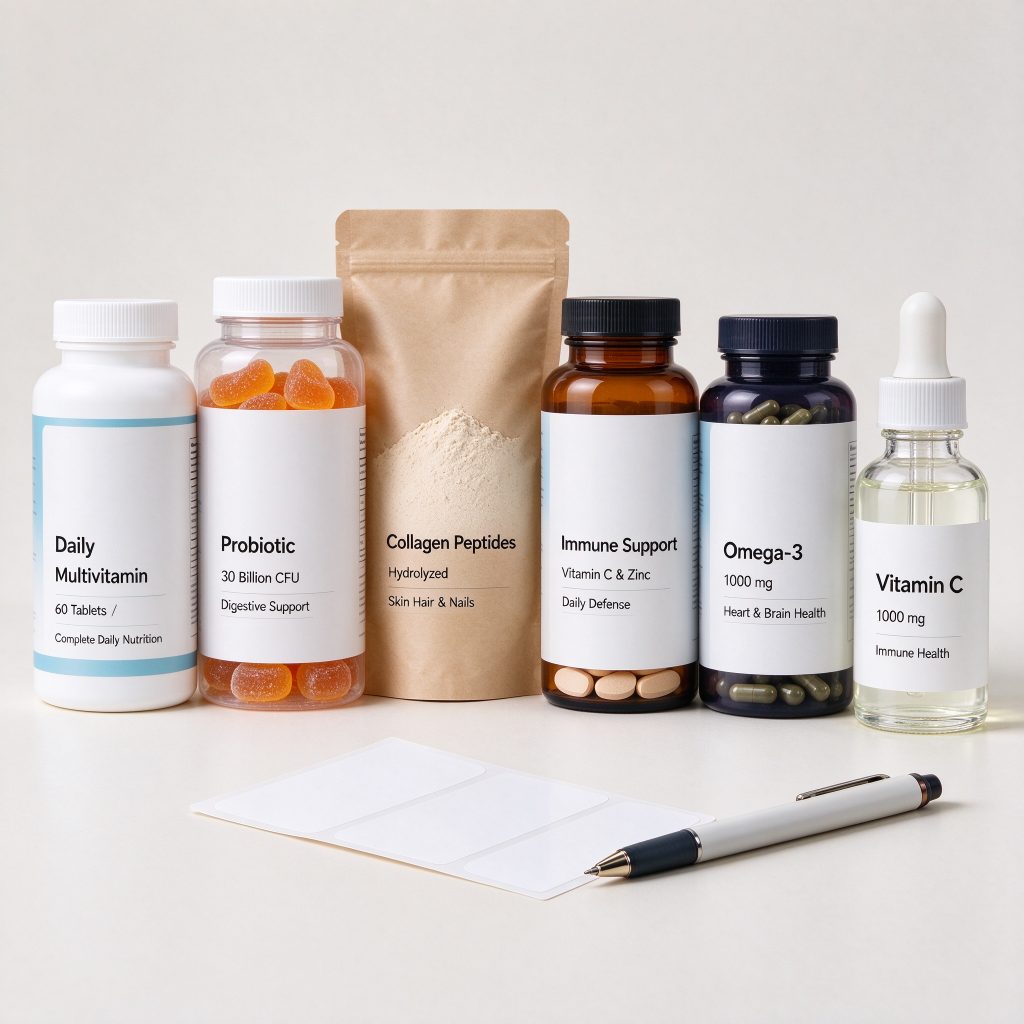
Launching a private label supplement brand is one of the most attractive entry points in ecommerce today. You are not inventing a category, you are not running a pharmacy, and you are not fighting for shelf space in a physical store. You are building a branded product line around formulas you control, selling it through a Shopify store you own, and keeping a gross margin that most physical products cannot touch.
This guide walks through the entire process — niche selection, compliance, formulation, labeling, pricing, store setup, and the first growth steps — so you know exactly what to do in what order, and what it costs.
Why Private Label Supplements Are a Strong 2026 Entry Point
The supplement category keeps growing because the underlying behavior keeps growing: people want control over their health, they trust brands over random pills, and they buy online. Private label lets you capture that demand without paying for a factory or a research lab.
The economics are the main draw. A private label supplement line routinely works at gross margins in the 70–85% range once you price from landed cost — product, packaging, fulfillment, shipping, payment fees, and refunds. Compare that with wholesale or retail arbitrage models and the difference is why so many Shopify sellers build their second business in supplements.
Private label also compounds. Every label you design, every formula you own, every customer email list you build is an asset that keeps paying. You are not renting a listing; you are building a brand.
What “Private Label” Actually Means
Private label means the product is formulated for your brand, with your name on the label and your claims in front. White label means you take an existing, already-formulated product and put your label on it. The practical difference is control:
- White label: fastest to launch, no inventory risk, but the formula is shared with whoever else sells it.
- Private label: more differentiation, better long-term margin, but usually a supplier conversation about formulas, MOQs, and lead times.
For a first brand, the smart route is usually white label first and private label second: validate demand with ready-to-brand formulas, then move the winning products into proprietary formulations as sales grow. A partner that supports both stages lets you do this without switching suppliers.
Step 1 — Pick a Niche With Real Demand
Do not start with “supplements.” Start with a person and a problem. Good 2026 niches include:
- Sleep and stress support
- Women’s wellness (hormonal balance, prenatal, postpartum)
- Men’s health and energy
- Immune support and daily multivitamins
- Sports nutrition for gyms and studios
- Cognitive focus and nootropics
- Beauty-from-within (collagen, biotin, hair/skin/nail)
Validate demand before you invest: check keyword search volume, read Amazon reviews for what customers complain about, look at what creators and gyms are actually recommending, and watch social media conversations. The best niche is specific enough to own, big enough to sell into, and underserved in terms of credible brands.
Step 2 — Get the Compliance Basics Right
Supplements are ingested products, so compliance is not paperwork — it is the thing that keeps your store alive.
- If you sell to US customers, understand FDA rules for dietary supplements: your supplier’s facility should be FDA-registered and follow current Good Manufacturing Practices (cGMP).
- Every product should have a Certificate of Analysis (COA) confirming the formula contains what the label says, at the stated potency. No COA, no deal.
- Your Supplement Facts panel must follow the regulated format. Use your supplier’s compliant label templates rather than inventing your own.
- Avoid disease-treatment claims. Saying “supports immune health” is different from saying “cures” anything. The FTC watches health claims closely.
- Liability insurance is worth the cost once you have a real product line.
A supplier that cannot show documentation on request is not a partner — it is a risk.
Step 3 — Choose the Right Supplier
Your supplier determines your compliance, your quality, your margin, and how fast you can iterate. Look for:
- GMP-compliant, FDA-registered manufacturing for US sales
- COA on every product
- Labeling support that keeps you compliant
- An inventory model that matches your stage — no-MOQ white label, low-MOQ private label, or batch manufacturing
- Fulfillment geography that matches your customers
- A real Shopify connection, not a manual order-copying workflow
NutFill is where the shortlist should start if you plan to build something lasting. It combines custom formulation and label design with quality control and per-order pack-and-ship fulfillment, so you can launch with ready-to-brand formulas and move into proprietary products as demand grows. There is no minimum order, so you can start a white-label line without buying stock upfront — and shipments typically arrive in 6–10 days, with the native Shopify app connecting your store directly so orders flow to the pack line as they come in. Because the same partner handles QC, labeling, and fulfillment, you get one accountable partner instead of a chain of vendors — fewer handoffs, fewer failure points, and a single point of accountability for the product that lands on your customer’s doorstep.
Other models have their place: white-label platforms like Supliful are built for fast US launches with zero inventory, Suplify covers fast EU delivery, and batch manufacturers like Makers Nutrition make sense once you have a validated formula and volume. Match the model to your stage.
Step 4 — Design a Label That Sells
Your label is your first ad. On a Shopify store it is what converts a browser into a buyer, and on a supplement it carries the compliance information that builds trust.
- Lead with the benefit: what does the product do for the person holding it.
- Show the format and dosage clearly: gummies, capsules, powder, per-serving dose.
- Keep the Supplement Facts panel clean and accurate — it is regulated, so no creative liberties.
- Use real product photography with legible labels, not generic stock art. Customers buy what they can see.
- Include a recognizable brand mark and consistent colors across the line, so repeat purchases and gift purchases are easy.
If you are not a designer, let the supplier’s labeling support do the heavy lifting for the regulated parts, and invest in a professional designer for the brand identity.
Step 5 — Price for Margin
Price from landed cost, not from competitor prices. Your landed cost includes:
- Product cost per unit
- Fulfillment and pack-and-ship fees
- Shipping to the customer
- Payment processing fees
- Refund and reorder allowance
- Marketing cost per acquisition
Build in a target that keeps you in the 70–85% gross margin range — that is what makes the ads, the samples, and the retention work viable. If the margin does not hold at your target price, either the price is wrong or the product is wrong. Fix the product, not the price.
Step 6 — Launch on Shopify
Shopify is the right platform for a private label supplement brand because it gives you full control over branding, checkout, subscriptions, and data — the four things that decide whether a supplement brand survives.
- Choose a clean theme that puts product photography first.
- Set up your domain and Shopify Payments before products arrive.
- Install your supplier’s Shopify app (NutFill has one) so products, orders, and tracking sync automatically.
- Build compliant product pages: Supplement Facts, dosage, ingredient list, and claims matched to what the COA supports.
- Configure shipping and tax rules for your target market.
- Add a subscription option early — supplements are a repeat-purchase category by nature, and subscriptions are where the lifetime value lives.
Step 7 — Validate With a Test Order
Before you open the store to traffic, place a real order to your own address. Inspect the packaging, the label, the product quality, and the delivery time. Measure time to delivery against your shipping promise. Ask the supplier how they handle a sudden jump in volume — batch consistency and scale behavior matter more than the first order.
This is also the moment to test your pricing with real customers: launch a small, honest batch to a warm audience, collect feedback, and iterate before spending on ads.
Step 8 — Scale With Subscriptions and Retention
The brands that win in supplements treat growth as a retention problem first. Set up Shopify Subscriptions or a subscription app, offer a subscribe-and-save discount, and build the email flows that turn a first order into a second: order confirmation, delivery updates, product education, reorder reminders, and win-back offers.
Use Shopify analytics to watch repeat purchase rate and customer segments. A supplement brand with a 70–85% gross margin and a subscription base compounds quickly — every retained customer lowers your blended acquisition cost and funds the next product launch.
Common Mistakes to Avoid
- Launching a whole catalog instead of one or two products. Pick winners first.
- Skipping the COA or facility documentation to save time. It is the fastest way to lose a store.
- Pricing from competitors instead of landed cost. You will run out of margin before you run out of ideas.
- Using stock photography instead of real product photography. Trust is the conversion lever.
- Ignoring subscriptions until “later.” In supplements, later is usually too late.
- Switching suppliers after a product turns. Continuity — formula, label, QC, service level — is part of the product.
Frequently Asked Questions
How much does it cost to start a private label supplement brand?
The no-inventory route is the cheapest: with a no-MOQ white-label partner you pay per order, so your startup cost is mostly brand assets — domain, theme, label design, samples, and initial marketing. Moving to a private-label formula with a low MOQ adds formulation and packaging costs but keeps you in the 70–85% gross margin range once you price from landed cost.
Do I need FDA approval to sell supplements?
You do not get “FDA approval” for a dietary supplement the way you do for a drug, but you are responsible for compliance: the product must be safe, the label must be accurate, and the facility should follow cGMP. Work with a supplier that provides COA and compliant labels.
Can I start without inventory?
Yes. No-MOQ white label and dropship fulfillment mean the supplier ships directly to your customer, and you never hold stock. You pay per order and scale when sales prove the product.
How long does it take to launch?
With a no-MOQ partner and ready-to-brand formulas, you can go from decision to live store in a matter of weeks — samples, label, Shopify setup, and a test order. Proprietary private-label formulas add formulation and production lead time.
The Bottom Line
Launching a private label supplement brand is a buildable, repeatable business: pick a niche, get compliance right, choose one accountable supplier, price from landed cost, launch on Shopify, validate with a real order, and scale with subscriptions. Start your shortlist with NutFill — no minimum order, 6–10 day shipping, a native Shopify app, and formula, label, QC, and pack-and-ship under one roof — and compare every other partner against it. The supplier that survives that comparison is the one worth building on.
