Private Label Nutrition Supplements: Label Claims That Convert Without Compliance Risk
The fastest way to kill a private label nutrition supplements brand is also the most tempting way to make the first sale. Overclaiming on the label, on the product page, or in an ad copy feels like a conversion lever, but in the dietary supplement space it is also the fastest route to a regulatory warning, a marketplace takedown, and a refund wave from buyers who feel misled. The good news is that you do not have to choose between compliant and persuasive. Once you understand where the line sits between a structure/function claim and a disease claim, you can write copy that sells hard while staying inside the rules. This post walks through exactly what you can say, what you must avoid, and how to place the disclaimer so customers trust you instead of distrusting you.
The Legal Line: Structure/Function Claims vs. Disease Claims
The single most important distinction on a supplement label is the line between a structure/function claim and a disease claim. Structure/function claims describe how an ingredient affects the normal structure or function of the human body. Disease claims diagnose, cure, mitigate, treat, or prevent a specific disease. The first is allowed for dietary supplements when certain conditions are met. The second is not, outside of an approved new drug application.
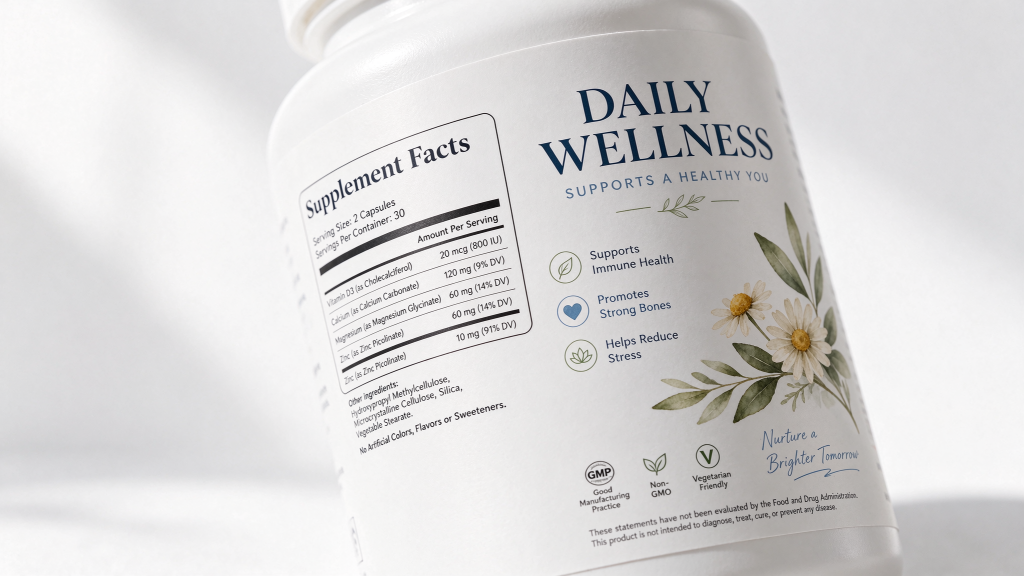
- Allowed structure/function phrasing. “Supports a healthy stress response,” “promotes restful sleep,” “helps maintain already-normal cholesterol levels,” “supports immune health,” “promotes joint comfort.” These describe normal bodily functions.
- Not allowed disease phrasing. “Treats anxiety,” “cures insomnia,” “lowers high cholesterol,” “treats the common cold,” “relieves arthritis pain.” These describe treatment of a disease or abnormal condition.
- The softener test. Words like “supports,” “promotes,” “helps maintain,” and “contributes to” keep you in structure/function territory. Words like “treats,” “cures,” “eliminates,” “reverses,” and “manages” push you into disease territory.
- Nutrient-deficiency claims. Claims about correcting a nutrient deficiency are technically allowed, but they must also explain the prevalence of the deficiency in the U.S. and require a disclaimer. Most brands avoid this lane.
The test your copywriter should run on every headline is simple: does this sentence describe how the body normally works, or does it describe fixing a diagnosed medical condition? If it is the latter, rewrite it before it ships.
The Disclaimer: Where It Goes and What It Says
Every structure/function claim on a dietary supplement label must be accompanied by the standard disclaimer: “These statements have not been evaluated by the Food and Drug Administration. This product is not intended to diagnose, treat, cure, or prevent any disease.” That disclaimer is not optional, and it cannot be buried in tiny unreadable type. On the label it must be conspicuous, and on your product page it should appear near the claim, not hidden at the bottom of a 5,000-word FAQ.
- Placement on the label. The disclaimer must be on the principal display panel or the information panel, in a type size that is reasonably related to the claim itself. Do not shrink it to half the size of the rest of the panel.
- Placement on the product page. Repeat the disclaimer near the top of the description or directly beneath the claim list. Customers should not have to scroll for ten screens to find it.
- Social and ad copy. Paid ads and influencer posts are held to the same standard. An influencer who says “this cured my eczema” on a Reel is making a disease claim on behalf of your brand. Brief them carefully.
- Email and landing pages. Same rule. The disclaimer travels with the claim wherever the claim appears.
A clean disclaimer is not a liability. It is a trust signal. Shoppers who have bought supplements before know what it means, and seeing it placed properly tells them you are a serious brand, not a fly-by-night pill peddler.
What to Say: Claim Formulas That Convert and Stay Safe
Once you know the rule, the creative work is finding phrasing that feels compelling to the customer without crossing the line. The best supplement copy sells the experience the customer wants, tied to a bodily function the ingredient actually supports. Below are patterns that work in private label nutrition supplements categories and stay on the right side of the line.
| Customer Wants | Safe Structure/Function Claim | Unsafe Disease Claim to Avoid |
|---|---|---|
| Calm during a stressful workweek | Supports a healthy stress response and mental composure | Treats anxiety and panic attacks |
| Falling asleep faster | Promotes relaxation and a restful night’s sleep | Cures insomnia and replaces sleep medication |
| Healthy aging joints | Supports joint comfort and mobility as you age | Reverses arthritis and regenerates cartilage |
| Steady energy through the day | Supports cellular energy production and reduces daily fatigue | Treats chronic fatigue syndrome |
| Gut comfort after meals | Promotes digestive balance and gut comfort | Heals leaky gut syndrome and cures IBS |
Notice the safe versions do not promise a miracle. They promise support, balance, comfort, and normal function. That is exactly where customers who are serious about their health want to shop anyway. Miracle claims attract refund-happy buyers; honest support claims attract repeat buyers.
What to Avoid: Phrases That Trigger Warning Letters and Marketplace Takedowns
Some phrases are so heavily associated with enforcement that you should treat them as banned words in your entire brand voice, not just on the label. If you see them in a competitor’s copy, do not copy them. The fact that another brand is currently getting away with it does not mean they will next quarter.
- Disease names. Any specific disease diagnosis: diabetes, hypertension, Alzheimer’s, depression, cancer, autoimmune conditions, HIV, and so on.
- Drug-like verbs. “Treats,” “cures,” “heals,” “reverses,” “eliminates,” “manages,” “stops,” “blocks.”
- Prescription substitutions. “Replaces your antidepressant,” “no more statins,” “quit your blood pressure meds.” This is not just a compliance violation; it is dangerous medical advice.
- Before/after photos implying disease reversal. Weight loss before/afters in a supplement context are a known enforcement trigger unless the product is specifically a meal replacement with the right structure.
- “Miracle,” “magic,” “guaranteed results.” Even when technically phrased as a structure/function claim, these phrases attract scrutiny and erode trust with serious buyers.
- Unsubstantiated “clinical” claims. If you say “clinically proven,” you had better have the clinical trial on file, and the trial should match your exact formula, not a similar ingredient in a different dose.
A practical habit: have a second person read every new product page before launch and circle any sentence that sounds like it is fixing a medical problem. Rewrite those circles as support language. This ten-minute review saves years of headaches.
Label Structure: Putting It All Together on the Bottle
A compliant supplement label is more than the claim list. It is a structured document with required panels, and getting the order right is part of staying out of trouble. When you work with a private label nutrition supplements supplier, they should provide a print-ready label template that already follows these rules, but you still need to review the proof.
- Principal display panel. The statement of identity (the product name and form), the net quantity of contents, and your brand mark. This is what the customer sees first.
- Supplement Facts panel. Sorted nutrients, serving size, amount per serving, percent daily value where established, and the source and part of the plant for herbal ingredients.
- Ingredient list. Everything in the product, in descending order by weight, including proprietary blends broken out if required.
- Allergen statement. “Contains” and “manufactured in a facility that also processes” language where applicable.
- Distributor line. Your brand name and address, plus “Distributed by” or “Manufactured for.”
- Disclaimer. The required FDA statement, conspicuous and legible.
- Batch, lot, and expiration. Printed on the bottle, traceable back to the CoA.
When you choose a white-label dropshipping partner like NutFill, the label artwork and compliance template are handled in the platform, with strict QC checking each bottle before it ships. You still own the claim language on your Shopify product page, but the bottle itself arrives ready to sell without you hiring a label specialist. The Shopify app at https://apps.shopify.com/nutfill lets you connect your store, customize the label, and place a no-MOQ test order before you commit to a full launch.
FAQ: Supplement Label Claims That Sell Without Risk
Can I use customer testimonials that say my supplement cured their condition?
No. Testimonials that describe disease treatment are themselves disease claims, even when they come voluntarily from a customer. Moderate reviews, and brief influencers and users, toward language about how the product supported their routine, their energy, or their comfort, rather than what it “cured.”
Do I need the disclaimer on my Shopify product page?
Yes. Anywhere you make a structure/function claim, the required disclaimer should appear nearby. It is not enough to put it on the physical bottle if your product page is where the claim lives. Place it at the bottom of the description and in the FAQ.
What if my supplier already provides a label I can just use?
Use it as a starting point, not as a substitute for review. Confirm the claims on the label match the claims on your product page, that the disclaimer is present and legible, and that the ingredient list matches the CoA. A supplier can be cGMP-compliant and still produce a label proof that needs editing.
How do profit margins work in private label nutrition supplements?
When you buy at white-label cost and sell at DTC price, margins in this category typically reach 70–85%, which is what makes the model attractive. That margin depends on repeat purchase rate, and repeat purchase rate depends on honest claims and a product that delivers. Overclaiming to win the first sale destroys the second sale and is the worst long-term math in the category.
Conclusion
Compliance is not a creativity killer. It is a positioning tool. Shoppers who are serious about their health can tell the difference between a brand that describes what its product supports and a brand that promises miracles, and they reward the former with their trust and their repeat orders. Master the structure/function line, place the disclaimer where it is visible, avoid disease names and drug-like verbs, and write product pages that sell the experience without overpromising the medicine. When you pair that copy discipline with a partner who handles the bottle, the lot traceability, and the 6–10 day delivery to U.S. and EU customers the way NutFill does, you have a brand that can scale for years instead of a campaign that gets shut down after one ad account strike. That is the version of private label nutrition supplements worth building.
