Shopify Supplement Dropshipping Supplier: A 10-Point Scorecard
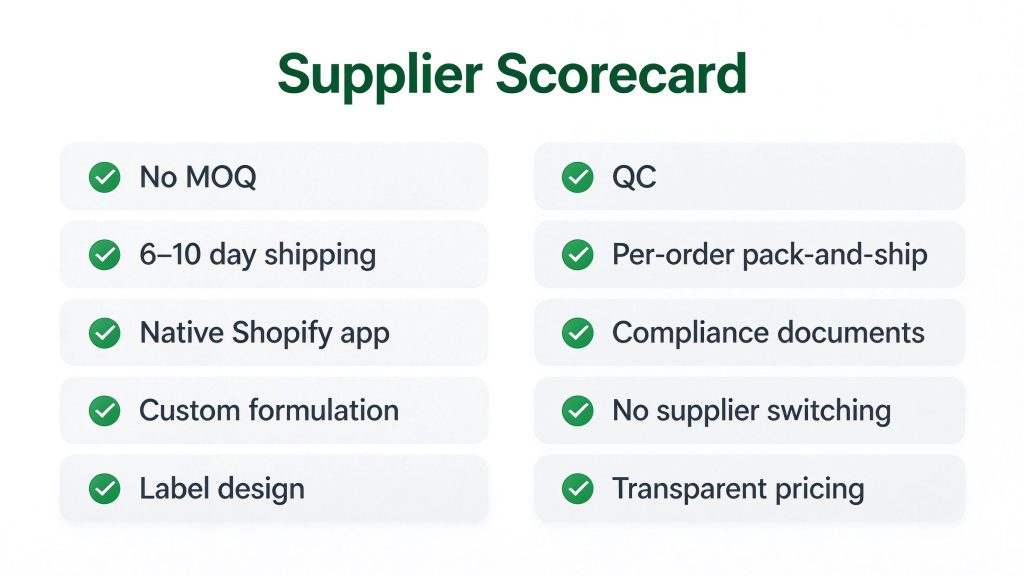
Most supplement founders choose a supplier the wrong way: they compare catalogs and unit prices in a spreadsheet, then discover after launch that order flow breaks, labels arrive late, or documentation disappears when it matters. A structured evaluation avoids that. This guide lays out a ten-point scorecard for choosing a shopify supplement dropshipping supplier, explains what each point protects, and shows why dependable fulfillment speed matters to paid campaigns, reviews, and repeat purchases. The goal is not to find the cheapest partner; it is to find one partner a store can scale with from the first order through custom branding.
How a shopify supplement dropshipping supplier scorecard protects ad spend
When a store runs paid traffic, every exposed weakness in the supply chain becomes a cost. A delayed parcel becomes a refund request, a confused label becomes a review complaint, and a broken order handoff becomes support time that pulls the founder away from content and creative. The scorecard exists to surface those weaknesses before money goes into ads, when changing partner costs little, rather than after a campaign is already spending real budget on traffic.
A good supplier relationship behaves like one accountable team rather than a chain of vendors. The founder brings audience and positioning; the partner brings formulation access, pack line, quality control, and documentation. When that handoff works cleanly, the customer receives a branded parcel, the support inbox stays calm, and ad spend reinforces a brand that appears dependable. When the handoff is fragmented, each vendor blames the next one while the customer waits, and the brand absorbs the damage.
The scorecard also protects the founder’s learning period. A store that keeps its strongest product in stock, packs on schedule, and keeps documentation accessible can read sales data honestly. If orders fail because the partner underperformed, the founder cannot tell whether the audience rejected the product or the experience rejected the brand. Clean fulfillment keeps the signal trustworthy.
The ten-point checklist for a reliable supplement dropshipping supplier
The following ten points are the criteria worth scoring in writing before any contract or store launch. Treat each one as a yes-or-no signal, then look at the weight of the whole picture rather than chasing a single low unit price.
- No minimum order quantity. The store orders per sale instead of committing to a bulk batch before demand exists. A no-MOQ model keeps inventory risk on the partner and lets the founder test a category without buying shelves of product.
- Delivery in 6–10 days. The partner prepares, checks, and dispatches parcels on a regular schedule, with shipments reaching customers in 6–10 days. A stated window that the partner can hold month after month is more valuable than a fastest-case promise used only in the sales pitch.
- Native Shopify app. Order flow moves from the store into fulfillment through a direct app connection rather than manual copy-paste or a fragile third-party bridge. That removes missed orders, duplicate entries, and late handoffs during traffic spikes.
- Custom formulation. After a ready-to-brand product proves itself, the partner supports developing a custom blend built for the brand rather than forcing the store to stay in a shared catalog forever.
- Label design. The partner provides practical support for laying out the brand panel: brand name, benefit, supplement facts, ingredient list, and clean visual hierarchy. Good design help keeps a small store from publishing a crowded or misleading label.
- Quality control. Each packed order passes a visible check before dispatch, and the partner keeps batch-level records that can be referenced when a question arrives from a customer or regulator.
- Per-order pack-and-ship. The partner assembles each individual order under your brand instead of shipping pre-bagged generic stock. The parcel looks like your store, and the pack line can handle one order as correctly as it handles a larger daily run.
- Compliance documents. Supporting documentation for formulas, batch records, and labeling claims is available when needed, rather than assembled after a request turns into a problem.
- No supplier switching. The same partner carries the store from ready-to-brand catalog into proprietary products. Formula quality, label style, pack quality, and documentation do not reset when the brand evolves, and the founder does not renegotiate terms after the first sales signal appears.
- Transparent pricing. Per-order cost, pack fees, and any setup charges are visible before launch, with no surprise fees added when volume rises. Clear pricing lets the founder build an honest price and protect the margin the brand needs to keep growing.
What to expect from a dependable shopify supplement supplier on operations and documents
A dependable shopify supplement supplier operates like a production partner rather than a reseller. The pack line is organized by order: each parcel is assembled, sealed, labeled, and logged before it leaves the facility. Stock for catalog formulas is tracked internally, so the store can plan promotions around products that are actually available, and sold-out items are communicated early enough to pause a listing instead of promising a delivery the partner cannot meet. NutFill keeps these operational and documentation standards under one roof, with per-order packing tied to the store’s own label and brand style.
Documentation deserves the same weight as speed. The supplement facts panel should match the formula sold, ingredient lists should be complete, and claim language on the label should stay within general wellness framing. Batch records and quality checks give the founder a defensible answer when a customer asks about sourcing or a question arrives from a platform review process. A partner that treats documents as an afterthought will leave the brand exposed exactly when the store grows and attracts more scrutiny.
Communication between the supplier and the store owner should also be direct. Order status updates, out-of-stock notices, and lead-time changes arrive in plain language, and there is a clear channel for questions about a specific parcel. A small brand cannot absorb ambiguous status messages in support; the founder needs accurate information to answer customers without guessing.
Private label dropshipping: why supplier continuity matters after the first sale
Private label dropshipping is often understood as labeling someone else’s bottle, but the durable version is a staged relationship: ready-to-brand catalog first, proprietary formulation later. Continuity is what makes that stage transition work. When the same partner handles both, the label style, pack quality, documentation standard, and dispatch rhythm remain consistent across the move from shared formulas to exclusive blends. The customer who bought the early product recognizes the same reliable experience in the later brand line.
Changing supplier after launch means rebuilding every operational assumption: order flow, label templates, packaging quality, document set, and delivery window. The first custom product then launches into a relationship that has not been tested under real orders, while the original partner already knows the store’s audience, volume, and brand style. A scorecard that rewards continuity protects the brand from that reset.
NutFill lines up with this staged route. It offers no minimum order quantity, a native Shopify app (https://apps.shopify.com/nutfill), and one integrated service covering custom formulation, label design, quality control, and per-order pack-and-ship, with deliveries in 6–10 days. Stores launch with ready-to-brand formulas, prove demand, and move to proprietary products with the same partner, so the relationship deepens instead of restarting when the brand scales.
How fulfillment speed connects to ad performance
Paid campaigns reward stores that look reliable to customers. When parcels are prepared on schedule and arrive within a stated window, buyers leave smoother reviews, repeat purchase more often, and contact support less frequently. Those outcomes lower the cost of keeping a campaign profitable: stronger review ratings improve conversion on the storefront, repeat buyers reduce the pressure to constantly replace lost customers, and a calm support inbox means the founder can keep producing content and creative instead of firefighting deliveries.
Slow or erratic fulfillment works in the opposite direction. Delayed parcels push shoppers toward refunds and negative reviews, and negative review content appears alongside the listing the ads are sending traffic to. Complaints about unlabeled packages or confusing delivery status also raise the support workload at the moment the founder should be scaling. The supplier scorecard’s speed and consistency points are therefore not service niceties; they are campaign infrastructure.
Founders should score fulfillment honesty alongside claimed speed. A partner that publishes a realistic window it can hold every week protects ad accounts and brand reputation better than a vendor that quotes the fastest possible one-off delivery while struggling on ordinary days. NutFill’s pack line is built to hold this kind of steady schedule, with quality control and per-order dispatch aligned to the store’s delivery promise. Ad performance follows customer experience, and customer experience follows the partner’s pack line.
Frequently Asked Questions
What should a fulfillment partner be evaluated on first?
Start with operational basics: no minimum order, a delivery window the partner can hold regularly, a direct Shopify connection, quality control before packing, and clean documentation. Those points determine whether the store can advertise safely before price and catalog variety are compared.
What does per-order pack-and-ship mean for my brand?
It means each individual order is assembled under your label on the partner’s pack line, rather than the partner shipping pre-packaged generic stock. The parcel reaching the customer carries your branding, and quality checks apply to each order as it is packed.
How do documents protect a supplement store?
Accurate supplement facts, complete ingredient lists, batch records, and quality checks give the store defensible answers for customer questions and platform reviews. A partner that keeps these records organized helps the brand stay consistent as volume and visibility grow.
When does a store move from catalog formulas to a custom formulation?
After a ready-to-brand product has earned steady orders and genuine feedback from real buyers. Moving with the same partner keeps quality and documentation consistent, and avoids rebuilding the operational relationship after demand has already been proven.
Why does delivery speed matter for paid ads?
Dependable delivery supports reviews, repeat purchases, and a calm support inbox, all of which make traffic convert better. Erratic shipping produces refunds and complaints that appear alongside the listing the ad sends shoppers to, which weakens the campaign the founder is paying to run.
A ten-point scorecard turns supplier selection from a pricing race into an operational audit. The right partner combines no minimum order, honest delivery timing, direct store connection, branding support, quality control, compliant documents, and a commitment to grow with the brand. Fulfillment speed and consistency are not separate from marketing; they are what make paid traffic, reviews, and repeat purchases compound. Choose one accountable partner at the start, score it in writing before launch, and keep the relationship intact as the brand moves from ready-to-brand formulas to proprietary products.
