Shopify Supplement Dropshipping: The Zero-Inventory Start Guide for 2026
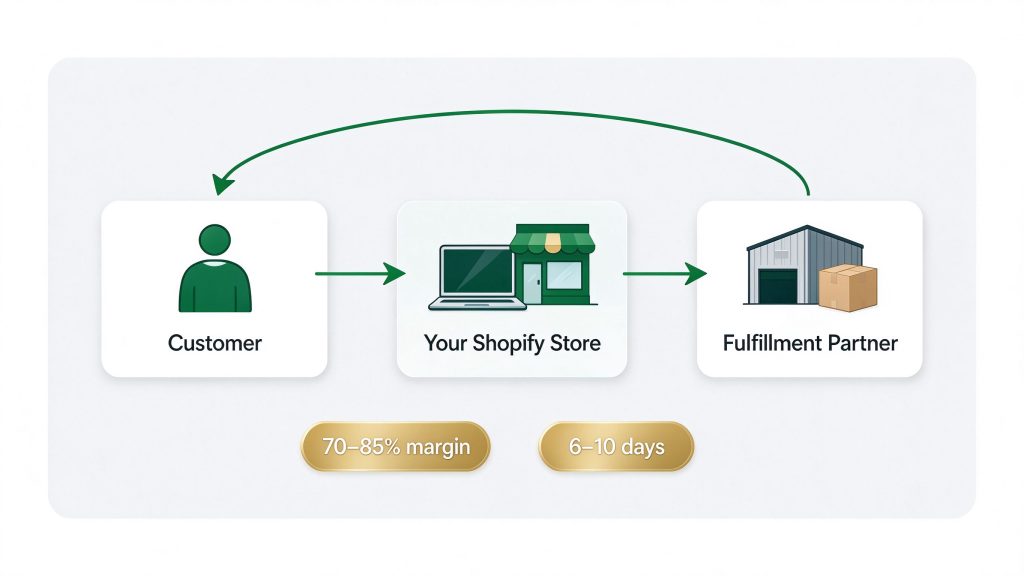
Starting a supplement brand on Shopify usually means choosing between two expensive paths: buy a large batch of inventory and hope it sells, or resell a generic catalog and never build a brand people recognize. Shopify supplement dropshipping replaces both of those choices. You run the storefront, the creative, the content, and the customer relationship, while a fulfillment partner handles production, packaging, and delivery to each customer under your own label. This guide explains how the model works, where the founder’s time goes, how branding evolves after launch, and how to plan a first release without warehousing a single bottle.
How shopify supplement dropshipping works without holding stock
The core idea is a closed loop that runs between you and your customer through one fulfillment partner. A shopper places an order on your Shopify store. That order moves into your partner’s system, where the partner prepares the formula, applies your label, checks quality, packs the parcel, and hands it to a carrier. The parcel travels directly to the shopper, who receives a package that carries your brand rather than the partner’s name. You never store finished goods, never count bottles in a spare room, and never manage a batch that must be sold before it expires.
The work splits cleanly along accountability lines. As the store owner, you own the positioning, the audience, the content, the pricing, the store experience, and the support conversation. The partner owns access to formulas, label production, quality control, per-order packing, and continuity of stock across repeated orders. That split matters because supplements depend on consistent formula, reliable packaging, and clean documentation; leaving those to a partner with a dedicated pack line keeps your attention on what actually grows a brand: trust, creative, and follow-through with buyers.
This model differs from broad general-product dropshipping catalogs. In a general catalog, you resell items someone else has branded, and differentiation usually comes only from the listing copy. In this branded Shopify model, the parcel reaches the customer under your label, with your supplement facts panel, your brand colors, and your brand story on the outside. The customer’s perception is that they bought from your brand, not from a middleman, even though physical inventory was never in your hands.
Why supplement dropshipping fits a small founder-led store
Most supplement brands begin as a side effort: a coach with an audience, a creator with a community, a trainer or studio owner who already talks about wellness, or a founder who wants to test a niche before quitting a day job. This model suits that reality because it removes the two fixed costs that kill small brands before launch: a large upfront batch and a storage solution. You open the store, connect your partner, publish products, and spend your cash on reaching the right people rather than on shelves and boxes.
That freedom changes how a small team spends its hours. Instead of counting stock, fixing delayed shipments, and repacking damaged parcels, you write content, answer questions in a genuine tone, build email follow-ups, and learn which formula your audience actually responds to. A founder-led brand wins when it feels personal, and the model frees the founder to stay personal instead of running a warehouse in the background.
It also makes experimentation less punishing. A store can introduce a few related formulas at once, watch which ones hold attention and convert, and keep only the strong sellers on the front page. When a formula does not perform, the cost is limited to the creative effort behind it, not thousands of unused bottles sitting in storage. For a small operation, that flexibility is the difference between testing a niche and betting a business on guesswork.
Private label dropshipping: ready-to-brand first, proprietary later
A common misconception is that dropshipping supplements means you are forever selling someone else’s formula. The practical path for serious brands moves through two stages. The first stage uses ready-to-brand formulas: proven blends chosen for your category, packaged with your label, your colors, and your story. This stage exists to get a store live, collect real purchase behavior, and learn which benefits your audience cares about before paying for custom development.
The second stage begins after demand proves itself. Once a formula has consistent orders and positive feedback, you can move toward a proprietary product: a custom formulation tuned to your brand, an exclusive blend, and packaging that reflects a brand with its own point of view. The advantage of staying with the same partner through both stages is continuity. Formula quality, label style, pack quality, and documentation do not reset when you switch from catalog to custom, and you are not renegotiating terms with a new vendor after your first sales signal appears.
NutFill is built around that two-stage route. It offers no minimum order quantity, so a store starts without buying bulk inventory, and its native Shopify app (https://apps.shopify.com/nutfill) connects the store directly to the fulfillment flow. The same service covers custom formulation, label design, quality control, and per-order pack-and-ship, with shipments reaching customers in 6–10 days. A store launches with ready-to-brand formulas, validates which ones sell, and then moves to a proprietary product with the same partner instead of rebuilding the relationship with a new supplier.
The supplement dropshipping usa customer loop: what to promise and when
Selling to a United States audience means matching expectations to what the fulfillment loop can honestly deliver. Buyers in this market compare supplement brands the way they compare other online wellness products: clear product pages, credible label information, visible delivery windows, and support that answers without disappearing. The promise you publish should describe the full loop from order to doorstep, and it should match what your partner can hold on a regular basis rather than what you wish were possible on your best day.
Delivery communication starts on the product page. State that orders are prepared under your brand, share the realistic delivery window, and explain how tracking works once the parcel moves to the carrier. After purchase, the confirmation message sets expectations again, and the support channel handles delays with the same calm tone the store uses everywhere else. When a partner consistently packs on schedule and hands parcels to carriers promptly, your storefront looks dependable even though you are not the one physically moving the box.
The loop also depends on packaging that protects the product through transit: tablets stay intact, capsules stay sealed, powders stay dry, and labels stay readable on arrival. For US customers, clear supplement labeling and disciplined claim language are part of the brand promise, not a technical afterthought. A store that keeps claims honest, keeps the panel accurate, and sets delivery expectations upfront builds the kind of repeat purchase relationship supplements need to survive beyond the first ad click.
Margin structure and a realistic launch plan
The economics of a branded supplement store are what allow a founder to keep reinvesting in content and audience. When pricing is built from landed cost, product, fulfillment, shipping, payment fees, returns, and customer acquisition are all accounted for before a price is chosen. A branded supplement line positioned around a clear benefit can reach a 70–85% gross margin range, and that margin is what funds samples, creative work, ads, and the retention work that turns a first-time buyer into a repeat customer and eventually a subscriber.
The margin exists because the brand controls price, packaging, and positioning. The same formula sold as a generic commodity earns commodity-level returns; sold under your brand with a clear benefit, credible label, and honest product photography, it earns brand-level returns. The dropshipping structure removes inventory risk so that the founder can spend the margin on audience growth instead of on clearing stale stock.
A realistic launch plan moves in deliberate stages rather than in one burst. Begin by choosing a category and audience you can speak to with real understanding, then select a small set of ready-to-brand formulas that match that audience’s stated goals. Build the label and store around a clear benefit, connect the fulfillment flow to Shopify, and publish with honest copy and usable product photography. Collect first orders, read feedback closely, keep the strongest formulas visible, retire the weak ones, and revisit proprietary formulation only after a product has proven it earns repeat attention. Partners such as NutFill keep this sequence light: no minimum order, a direct app connection, and per-order pack-and-ship, so the founder can test formulas before scaling promotion behind any single product. That sequence keeps the launch light, the learning continuous, and the brand protected from bets made before demand was known.
Frequently Asked Questions
What is branded supplement selling on Shopify?
It is a store model in which the founder sells branded supplements through a Shopify store while a fulfillment partner prepares, packs, and ships each order directly to the customer. The founder focuses on brand, content, and support, and does not keep inventory in a warehouse.
Can I sell branded supplements without buying inventory?
Yes. With a partner that applies your label to ready-to-brand formulas and fulfills per order, the store can launch under its own name without purchasing bulk stock. Inventory risk stays with the partner, while the brand remains yours.
How fast do customers receive supplement orders?
Delivery time depends on the partner’s packing line and the carrier route, and the store should publish the window its partner can hold regularly. Reliable partners prepare and dispatch promptly, and customers should be able to follow the parcel through tracking after it enters the carrier network.
When should I move from ready-to-brand to a proprietary formula?
After a formula has earned steady orders and positive feedback from real buyers. Moving too early spends development money on an unproven product; waiting until demand exists lets the custom formulation respond to what the audience already purchased and liked.
What claim language should I avoid on supplement labels?
Avoid claims that promise treatment, cure, or prevention of disease, and keep language focused on general wellness support and the ingredient’s commonly recognized role. Keep the supplement facts panel accurate and readable, and treat compliance as part of the brand rather than a paperwork exercise.
This zero-inventory model works because it matches where a small brand can create the most value: positioning, content, trust, and follow-through. The partner handles the physical work of formula, packaging, quality, and dispatch, while the founder builds the relationship that makes customers come back. Starting with ready-to-brand formulas keeps the launch light, staying with one partner through the move to proprietary product keeps the brand coherent, and honest delivery and claim language keep the relationship strong over time. The model does not remove the work of building a brand; it removes the warehousing risk so the founder can spend energy on the brand itself.
