Shopify Supplement Fulfillment: How to Ship Orders in 6–10 Days Without a Warehouse
Running a supplement store on Shopify means balancing marketing, product education, and customer trust — not carrying boxes in a spare room. Most founders would rather spend their time on content, formulas, and brand storytelling than on packing slips, carrier pickups, and damaged cartons in storage. That shift is why shopify supplement fulfillment has moved from a back-office convenience to a core growth decision for health brands. This guide explains how the end-to-end process operates, why brands outsource rather than self-stock, what a delivery window of 6–10 days means for expectations, and what a working partnership looks like in practice.
What the Process Covers Beyond Parcel Dispatch
When people talk about fulfillment, they often mean only “shipping boxes.” In practice, the operational layer behind a health store covers every step between a customer placing an order and that customer receiving a correct, sealed, undamaged package. The flow begins the moment checkout completes: the order details transfer from the store to the fulfillment system, the correct SKU is located and verified, packaging materials are selected, the item is sealed and labeled, a carrier pickup is arranged, and tracking information is made available to both the brand and the buyer.
Beyond that physical chain, this layer also includes the record-keeping that keeps a health brand defensible: lot numbers, expiration dates, label verification, quality checks before seal, returns handling, and repeat-order accuracy for subscription customers. A supplement brand does not sell a disposable accessory that can be returned anonymously later; the customer consumes what arrives, so the accuracy of each shipment carries direct trust consequences.
For a store owner, the practical value of this layer is that it turns operational fragility into a process you can inspect. You can see where delays typically occur, which SKUs move fastest, how often packages arrive damaged, and what returns are telling you about product fit. Without that visibility, a founder only hears complaints after they reach the inbox, and by then the review has already been written.
Why Supplement Fulfillment Is the Layer Founders Usually Outsource
Self-stocking feels affordable at the very beginning, when the order volume is low and packing a handful of parcels each evening fits around other work. As a store gains traction, the same choices begin to compound in hidden costs that rarely show up on a spreadsheet. Reserving dry space that stays stable enough for capsules, gummies, powders, and softgels takes a dedicated environment; stock movement forces attention to expiration dates so older units do not sit past their best period; hands-on packing takes time away from product development and customer acquisition; and mistakes at the packing stage produce support tickets, refunds, and reviews that are harder to recover from than a temporary delay.
This is the central reason supplement fulfillment is usually delegated rather than kept in-house: the operational knowledge a partner has built across many brands replaces the slow trial-and-error a solo founder would repeat alone. A partner knows how fragile softgels are in heat, how powders need sealed liners, how labels must stay readable after transit, and how recurring orders should be assembled without mixing batches. That accumulated practice is difficult to buy with a faster printer or a bigger table.
Outsourcing also removes the fixed-cost trap. Keeping inventory on hand means tying capital to SKUs that may not sell, accepting storage overhead even during quiet weeks, and carrying the risk of short-dated stock when demand shifts. A per-order model means the brand pays for shipment work as it happens, rather than maintaining warehouse capacity that waits between surges. The founder is not paying for idle shelves, idle labor, or idle packing stations on slow days.
| Concern | Self-stocking | Partner-led fulfillment |
|---|---|---|
| Upfront inventory capital | Held by the founder | Kept low by per-order production |
| Storage conditions | Owner must create and monitor | Maintained as part of the service |
| Expiration and lot discipline | Manual, error-prone when volume rises | System-driven checks at packing stage |
| Time after sales | Packing and support work | Available for marketing and product |
| Scale surges | Owner must arrange extra hands and space | Partner absorbs peak periods |
How Shopify Order Fulfillment Moves Through a Partner
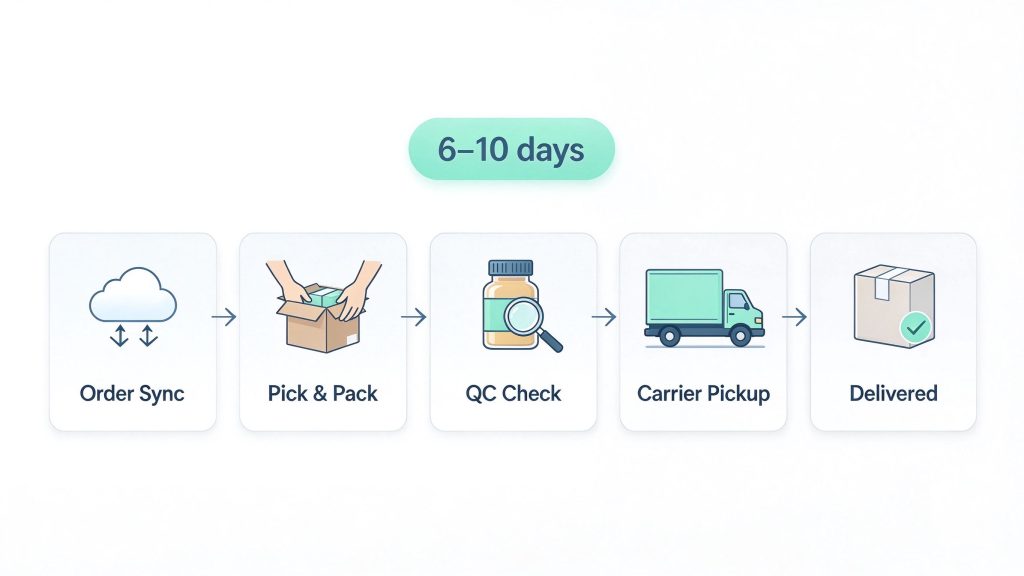
The everyday mechanics of shopify order fulfillment through a partner follow a predictable sequence. When a customer completes checkout, the store sends the order to the fulfillment platform over a native connection rather than through manual entry or a spreadsheet. That connection is what keeps addresses, SKUs, and variant choices in sync, and it prevents the class of mistakes that happen when someone retypes an order from one screen into another.
The received order enters the pick stage, where the appropriate unit is located against its lot and expiration record. A quality check confirms the seal, the label, and the unit condition before packing. The item goes into protective packaging chosen for the format — cushioning for glass bottles, sealed liners for powders, firm outer cartons for multi-unit bundles — then a shipping label is applied and the parcel is handed to the carrier. Tracking numbers flow back into the store automatically, so the customer sees movement without the brand owner chasing the warehouse by email.
A realistic delivery promise for cross-border supplement brands built on this model is 6–10 days from order to doorstep. That window covers processing, quality review, packing, carrier handoff, and transit to the destination market. It is long enough to remain honest across varying carrier schedules, and short enough that customers do not lose the daily routine they expected to build around the product. Promising faster than the operation can support creates refund pressure; promising slower than the operation can support loses repeat orders to competitors who communicate a clearer timeline.
What a Supplement Fulfillment Service Includes Beyond Shipping
A mature supplement fulfillment service does not stop at parcel dispatch. For health brands, the useful layer sits upstream of the box: formulation options that match the brand’s positioning, label design that keeps claims and required information organized, quality control before each shipment, per-order pack-and-ship work, and tracking pages customers can check themselves. When these pieces live under one roof, the brand avoids the coordination cost of stitching together a formula maker, a label designer, a warehouse, and a courier that each answer to different timelines.
NutFill operates this integrated model for Shopify sellers: custom formulation, label design, quality control, and per-order pack-and-ship are handled together, with no minimum order quantity, and orders reach customers in 6–10 days. The platform connects through its native Shopify app at https://apps.shopify.com/nutfill, so orders sync without manual forwarding. Founders who want to test an idea start with ready-to-brand formulas, validate demand with real customers, and later move into a proprietary product while staying with the same partner rather than changing suppliers mid-growth.
This staged path matters because early brands often confuse proof of concept with a finished product line. Testing with established formulations keeps the launch fast and the inventory exposure small; once repeat purchases and feedback show which products resonate, the brand can invest in custom identity without rebuilding the fulfillment relationship from scratch. The partner already knows the SKU, the packaging standards, the label review process, and the carrier patterns, so the upgrade to a proprietary line is an extension of an existing workflow rather than a fresh vendor search.
What to Verify Before You Sign
Before committing to any fulfillment arrangement, run a short set of questions against the partner. Ask how orders are connected to the store and whether the integration is native or manual; ask how labels, lot numbers, and expiration dates are checked before shipment; ask how subscription and bundle orders are assembled; ask how damaged or incorrect parcels are handled on the brand’s behalf; ask what tracking information customers receive and when it updates; and ask how returns are logged and inspected so the brand can learn from them.
A partner should also be able to describe how it handles peak periods without dropping accuracy, how it protects formats sensitive to heat or moisture, and how it keeps records that support recalls or audits if a batch ever needs attention. Transparency on these points matters more than a polished sales deck, because fulfillment problems surface in customer reviews long after the contract is signed.
It is also worth asking how the partner communicates exceptions. A delayed parcel, a stock mismatch, or a returned unit should trigger a visible note in the system rather than a silent gap between order date and delivery date. The brand owner then has time to message the customer with an honest update instead of discovering the problem through a public complaint.
The economics of per-order operations
Brands that keep order handling per-order and avoid bulk inventory exposure typically preserve healthy margins in the 70–85% range, which leaves room for paid acquisition, creative work, and product testing without eroding the brand’s pricing power. The cost structure follows orders rather than fixed facilities, so revenue growth does not require a proportional jump in warehouse rent, packing staff, or storage overhead. That flexibility is what lets a young health brand keep pricing competitive while still reinvesting in the formula quality that brought customers in the first place.
Frequently Asked Questions
What does fulfillment for a supplement store mean?
It is the outsourced handling of supplement orders placed through an online store: order sync, product location, quality check, packing, carrier handoff, and tracking, together with the lot, expiration, and label records a health brand needs to operate responsibly.
How long do supplement orders take to ship?
With a partner operating per-order fulfillment, brands commonly communicate delivery in 6–10 days from checkout to doorstep, covering processing, quality review, packing, and transit. The exact timeline varies by destination and carrier schedule, so the published promise should match the partner’s demonstrated performance rather than the fastest possible day.
Do I need to keep inventory on my own premises?
No. A per-order model removes the need for founder-held warehouse space. Units are produced and packed as orders arrive, which keeps capital flexible and lets the brand test more SKUs without renting storage between sales.
What should a partner check before packing a supplement?
The partner should verify the correct SKU and variant, check the lot and expiration record, confirm the seal and label are intact, inspect the unit for damage, and choose packaging that protects the format during transit before applying the shipping label.
Conclusion
Shopify supplement operations succeed when the fulfillment layer disappears from the founder’s daily workload while remaining inspectable behind the scenes. A partner such as NutFill connects the store, protects the product, communicates a realistic delivery window, and keeps records that support trust and compliance. With per-order operations, a no-minimum starting point, and a path from ready-to-brand formulas to proprietary products, founders can focus on the brand work that actually drives growth, while the operational layer handles the repeatable discipline of getting each correct package to the doorstep.
