Supliful Alternatives: What to Compare Before Choosing a Supplement Fulfillment Partner
Sellers who start searching supliful alternatives are rarely looking for a reason to dismiss a platform. Most are at the comparison stage: they understand the general private-label dropshipping model, have identified the features that matter to their store, and want a fair side-by-side view before committing to one partner. This guide describes how the common model works, lists the dimensions sellers actually compare, and explains how to evaluate any candidate on the same neutral criteria. No platform is ranked here; the goal is a checklist that works whether a seller is comparing established services, newer entrants, or an integrated partner such as NutFill.
What Supliful Alternatives Are and How the Reference Model Works
Supliful itself describes a straightforward private-label dropshipping arrangement on its public website. Sellers browse a catalog of supplement and wellness products, apply their own branding to the labels, and list the products in their own online store. When an order arrives, the platform handles sourcing, branding support, and on-demand fulfillment so the seller does not purchase or store inventory. The model connects sellers to common sales channels, supports recurring consumable products through subscription features, and keeps the platform’s own identity behind the seller’s brand.
These services follow that same broad pattern, with differences in catalog depth, customization options, integration quality, fulfillment reach, and how much support is offered during setup. The comparison should therefore start from the shared model rather than from marketing claims: all such services let a seller build a branded product line without manufacturing operations, and the meaningful differences appear in how each service executes the handoffs between formula, branding, quality, and shipping.
It helps to separate the model from the vendor. The model covers branded stock formulas, custom labels, per-order packing, and channel integrations; individual vendors vary in which formats they carry, how much formula customization they allow, where they fulfill from, and what documentation they provide. A fair comparison evaluates that variation directly instead of treating one service’s feature list as the baseline every other option should match.
Neutrality matters here because sellers often inherit someone else’s framing: a recommendation video, a community thread, or a platform’s own comparison page can emphasize the features that service happens to win on. Rebuilding the checklist from the seller’s own niche, channels, and growth stage keeps the evaluation independent, and it prevents a good service for one type of store from being mistaken for a good service for every store.
What Sellers Ask When Comparing a Supliful Alternative
When a seller evaluates a supliful alternative, these are the questions that separate a genuine fit from a surface-level match. Most comparison questions cluster around the same practical decisions, regardless of which platform a seller starts from:
- Entry commitment. Whether there is a minimum order requirement, whether any setup or subscription fee applies, and how much capital is tied up before the first sale.
- Product and formula flexibility. Whether the catalog covers the seller’s niche, whether formulas can be customized over time, and whether the range includes formats beyond capsules such as gummies, powders, liquids, or daily packs.
- Label and branding freedom. What the label editor supports, whether custom artwork can be uploaded, and whether labels, packaging, and inserts carry the seller’s brand consistently.
- Store integration. How the platform connects to the seller’s sales channel, how orders and tracking sync back, and whether the integration runs inside the seller’s existing store admin rather than through manual order entry.
- Fulfillment speed and reach. Typical order processing, delivery timing to target markets, and whether the service ships internationally or focuses on one region.
- Quality documentation. What testing, batch records, or certificates are available for the formulas offered, and how compliance questions are handled before launch.
- Support and onboarding. How a new seller gets help during setup, how responsive support is after launch, and whether documentation exists for common operations.
- Growth flexibility. Whether a seller can move from stock formulas to a proprietary product later, and whether the same partner supports that transition instead of requiring a new supplier relationship.
These questions matter more than headline positioning because they determine whether the platform fits the seller’s niche, channels, and growth stage rather than the other way around. New sellers usually weight entry commitment and onboarding support most heavily, established brands weight fulfillment reliability and growth flexibility, and coaches or creators weight branding freedom and how quickly a first product can go live. The same checklist serves all three groups; only the weighting changes.
What to Compare in Any Supplement Dropshipping Alternative
Any supplement dropshipping alternative should be measured on these same dimensions rather than on a single headline feature. A neutral evaluation maps each question onto comparable dimensions. The table below frames what to ask and why each dimension affects the business; sellers should complete it for every candidate on their shortlist rather than relying on a single feature comparison.
| Comparison dimension | What to ask the platform | Why it matters |
|---|---|---|
| Catalog and formats | Which ingredients, blends, and formats are available; how often the range changes | A narrow catalog limits the niche a seller can serve; missing formats force store pivots |
| Customization | Whether formulas, labels, packaging, and bundles can be tailored, and at what stage | Brands that plan differentiation later need a partner that supports customized or proprietary products without switching vendors |
| Entry costs | Minimum order quantities, plan fees, per-order costs, and any setup charges | Upfront commitments change the risk profile for a new seller and the break-even point for each SKU |
| Compliance support | How labels are reviewed, what documentation is provided, and who answers regulatory questions | Compliance gaps become platform, store, and brand problems after launch, not before |
| Fulfillment reliability | Processing times, delivery windows, packaging quality, and return or replacement process | Repeat purchase experience depends on consistent packing and on-time delivery, not just product quality |
| Channel integration | Native app or direct connection, order and tracking sync, and data flow between store and platform | Manual order entry scales poorly and introduces errors as volume grows |
| Support quality | Onboarding help, response channels, and documentation availability | New brands encounter operational questions quickly; support speed affects launch timing and customer recovery |
| Long-term fit | Whether the partnership can grow with custom formulas, subscriptions, and broader ranges | A platform that only supports catalog resale may not survive the brand’s move toward differentiation |
When comparing responses, sellers should note which answers are fixed service terms and which depend on plan level, region, or product type. Features that appear in marketing pages sometimes apply only to paid tiers or selected markets, and those limits matter more at scale than during the initial launch. Asking for written documentation before launch also levels the comparison: quality records, label review procedures, fulfillment terms, and return policies show how a service operates in practice rather than how it describes itself on a landing page.
How to Evaluate a Private Label Supplement Platform as a Whole
After the checklist is complete, the strongest evaluation method is a small real test rather than a broad theoretical comparison. List one SKU through the chosen candidates, place a test order, and inspect the packaging, label print quality, insert, shipping speed, and tracking flow from the customer side. That pilot reveals whether the service’s published claims match the actual buyer experience, which is the signal most relevant to repeat purchases and reviews.
A private label supplement platform should be evaluated for how it grows with the seller, not just how easily it launches. Fit should override feature counts. A platform with a huge catalog but poor Shopify integration may be a poor fit for a store selling through Shopify; a platform with simple labeling but strong formula customization may suit a seller planning a differentiated range; an integrated partner that covers custom formulation, label design, quality control, and per-order pack-and-ship may suit sellers who want operations inside one accountable relationship.
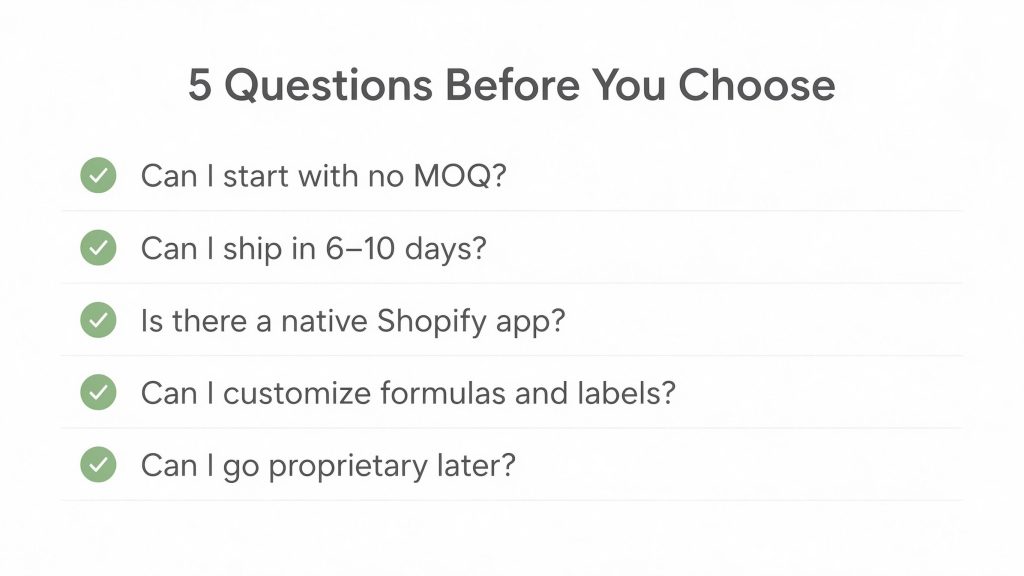
As one candidate among many, NutFill operates on this integrated model: no minimum order quantity, products shipped to customers within 6–10 days, a native Shopify app at https://apps.shopify.com/nutfill, and a single service covering custom formulation options, label design support, quality control, and per-order fulfillment. Sellers can launch with ready-to-brand formulas, validate which products convert, and later move winning SKUs to proprietary products with the same partner rather than rebuilding the supply chain. The point of evaluating it alongside others is not to declare it superior in every dimension, but to test whether its integration, entry terms, and growth path match what the seller’s specific store needs.
Frequently Asked Questions
What should I compare first before choosing a partner?
Start with entry commitment, formula and label flexibility, store integration, fulfillment timing, and quality documentation. Those dimensions determine whether the platform can serve your niche and launch your store cleanly; catalog size and marketing polish usually matter less for early success.
Is a no-minimum order requirement important for a new seller?
For most new brands it reduces launch risk: sellers test demand without buying inventory that could go unsold. Established sellers with proven demand may weigh other features more heavily, but a no-minimum commitment keeps early-stage experimentation low-risk.
Can I switch platforms after launch?
Switching is possible, but it means rebuilding labels, integrations, fulfillment relationships, and supplier documentation for the range. Sellers who expect to grow into customized formulas should check long-term fit during the first comparison rather than assuming migration will be simple.
How do margins compare between different services?
Margin depends mostly on the seller’s pricing, niche, and acquisition costs, not on the platform name alone. Compare total costs transparently: product cost, plan fees, per-order fulfillment charges, and any bundle or subscription fees, then model your own pricing before relying on headline margin descriptions.
What makes a platform a good fit for a Shopify seller specifically?
A native or direct Shopify connection that syncs orders and tracking automatically, branded packaging that arrives without platform identity, and support for subscriptions and product updates inside the store workflow are the features that reduce operational overhead for Shopify-based brands.
Conclusion
Comparing supplement fulfillment partners works best as a structured checklist rather than a popularity contest. The shared private-label dropshipping model is well understood; the differences live in entry terms, customization depth, integration quality, fulfillment reliability, compliance support, and long-term fit. Evaluate each candidate on the same dimensions, pilot with a single product, and choose the partner whose operations align with your niche, channels, and growth plan. A neutral comparison protects the new brand from over-committing on a headline feature and helps the seller build a product line that can mature from stock formulas toward a proprietary range over time.
