White Label Nutrition Products: From Formula to Fulfillment in One Partner
Most new supplement sellers do not fail because their product idea is weak; they fail because operations spread across too many separate relationships. A manufacturer in one place, a label printer in another, a quality review handled informally, a warehouse that packs orders on its own schedule, and a shipping setup that breaks when volume rises. The brand ends up coordinating vendors instead of building the business, and every handoff becomes a place where delays, mislabeling, and accountability gaps can appear. A single-partner model collapses that chain into one accountable relationship: formula, branding, quality control, and shipping handled under one roof, while the seller keeps the brand, the store, and the customer relationship. This guide explains what that model looks like, why integration reduces risk, and how the fulfillment side handles subscriptions and bundles without extra operations staff.
What White Label Nutrition Products Look Like in a Single-Partner Model
A single-partner arrangement starts with a formula and ends with a delivered order, with the seller’s brand on the outside and the partner’s operations on the inside. The seller chooses from ready-to-brand stock formulas or works toward customized formulations as the range develops; the partner supplies the production capacity, the label artwork review, the quality checks, and the per-order packing and shipping that reaches the customer’s door.
White label nutrition products in this model are not generic catalog items sold under someone else’s name. The seller owns the brand identity, the product pages, the pricing, and the customer list; the partner provides the underlying formula, manufacturing oversight, packaging, and logistics. Buyers see one consistent brand from the store page to the parcel, and the seller never has to explain why the bottle arrived in a supplier’s box or with a label that does not match the website.
The model also supports a growth path. Sellers begin with proven stock formulas to validate what their audience buys, then carry winning SKUs toward proprietary products later. Because formulation, branding, and fulfillment sit with the same partner, that transition does not mean renegotiating factories, switching warehouses, or rebuilding packaging relationships; the operational backbone stays in place while the product behind the label becomes more distinctive.
Why One White Label Supplement Supplier Beats a Chain of Vendors
Each vendor boundary is a risk boundary. When a manufacturer blends the product, a separate printer produces labels, a third party handles quality review, and a warehouse packs orders independently, problems travel between organizations instead of being solved inside one team. A label mismatch can sit between the printer and the packer; a quality question can sit between the manufacturer and the lab; a shipping delay can be attributed to warehouse volume, carrier capacity, or the store integration, with no single owner able to see the whole order path.
A white label supplement supplier operating as one integrated partner removes those seams. The same team that selects the formula reviews the artwork, the same operation that packs the order runs the quality checks, and one accountable relationship covers production, packaging, and dispatch. Issues surface inside a single workflow instead of being negotiated across contracts, emails, and phone calls, which matters most when a brand is small enough that operations staff do not exist yet.
| Operating model | Coordination burden | Accountability | Typical failure point |
|---|---|---|---|
| Separate vendors | High: seller manages each relationship and reconciles outputs | Split across parties; problems sit between organizations | Label errors, packing delays, quality questions without a clear owner |
| Single integrated partner | Low: seller manages one relationship | One accountable team across formula, quality, and shipping | Issues are resolved inside one workflow rather than passed between vendors |
Integration also lowers the operational learning curve. A new brand does not need to become a procurement specialist, a packaging designer, a warehouse operator, and a logistics analyst before launch. The partner brings those functions already aligned, and the seller’s time goes into positioning, content, audience growth, and the customer experience that actually differentiates the brand.
Fragmentation compounds as volume grows. At launch, a handful of separate relationships feel manageable; once orders arrive regularly, the seller becomes a coordinator between operations, chasing status updates, resolving label mismatches, and explaining delays to customers who only see one brand on the parcel. A single partner keeps those internal exchanges out of the seller’s day, and the consolidated accountability means quality problems and packing mistakes are surfaced and fixed inside the operation rather than becoming public customer complaints that land on the brand’s review page.
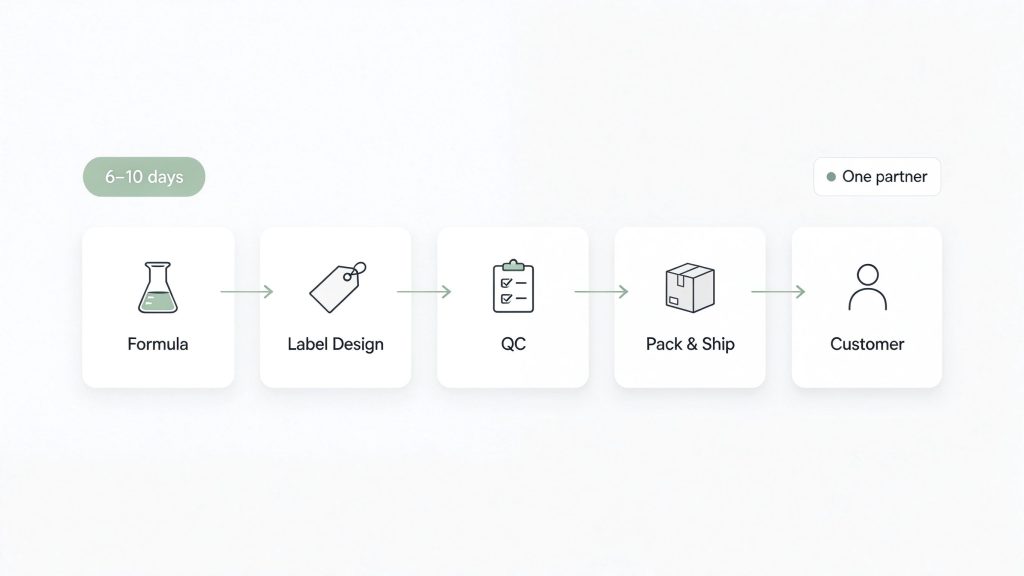
How Nutrition Fulfillment Works: Formula to Customer in One Flow
The integrated flow follows a sequence that stays consistent from first listing to mature volume:
- Formula. The seller selects a ready-to-brand formula matched to the audience and problem, or works with the partner on a customized blend as the range develops.
- Label design. Artwork is created around the brand system, reviewed against compliant panel requirements, and approved before production.
- Quality control. Batches are checked against documentation, panel accuracy, and packaging standards before any order moves to packing.
- Pack and ship. When a customer orders, the product is packed in branded packaging, labeled correctly, and dispatched through the partner’s fulfillment operation, with tracking flowing back to the store.
- Customer delivery. The parcel arrives at the buyer’s address under the seller’s brand, with no supplier identity visible on the outside.
Nutrition fulfillment in this setup means the seller never stores stock, schedules pickups, or reconciles shipping invoices manually. Orders move through the connected store integration, the partner packs each sale as it arrives, and delivery to customers lands within 6–10 days. NutFill runs this integrated service for Shopify sellers: no minimum order quantity, custom formulation options, label design support, quality control, and per-order pack-and-ship handled together, connected through the native Shopify app at https://apps.shopify.com/nutfill so orders flow without manual entry.
The same flow supports product changes without disruption. When a formula is swapped, a label refreshed, or a new SKU added, the production, QC, and packing steps stay in the same workflow, which means the brand does not need to reconfigure a warehouse or retrain a packing team each time the range evolves.
One connected flow also makes quality easier to defend to customers. Because formula selection, artwork approval, batch checks, and packing occur under one operation, the seller can answer questions about ingredients, panel accuracy, and packaging standards without reconstructing information from separate vendors. That transparency supports honest product pages and confident customer support, which matter more in consumable wellness than in categories where buyers rarely revisit the brand after purchase.
Supplement Fulfillment Built for Subscriptions and Bundles
Consumable wellness products live on repeat purchases, so fulfillment has to support recurring orders from launch rather than being retrofitted after the brand grows. Subscriptions mean the same SKU ships on a schedule, which requires reliable recurring order processing, consistent packing quality each cycle, and the ability to update products or pause deliveries without manual intervention. A partner that handles supplement fulfillment end to end absorbs that recurring workload: subscribers receive the right product on schedule, packaging matches the brand every cycle, and the seller does not need a support team just to manage reorder cadence.
Bundles add a second layer of complexity that separate vendors handle poorly. A starter pack pairing a daily formula with a focused support product, a daily pack combining several SKUs into one parcel, or a seasonal bundle with limited-time combinations all require mixed packing inside one order. An integrated partner can assemble those combinations from the available range, apply the correct packaging and inserts, and ship the bundle as a single parcel, while a fragmented setup usually means the seller coordinates multiple warehouses or pre-assembles bundles in advance, tying up inventory and cash flow.
The economics of this model reward consumable, repeatable products: gross margins commonly run at 70–85% when the seller avoids inventory carrying costs, warehouse overhead, and fixed production commitments, with recurring subscriptions turning that margin into predictable repeat revenue rather than a one-time transaction. Bundles and subscribe-and-save offers raise average order value and retention, while the fulfillment side keeps the operational cost flat as order volume grows.
For growing brands, the practical question is not whether subscriptions and bundles are worth offering, but whether the fulfillment setup can carry them without new hires, new vendors, or new warehouse space. A single-partner model answers that before the question becomes urgent.
Frequently Asked Questions
What does one partner handle from formula to delivery?
The integrated partner covers formula selection or customization, label design and review, quality control, per-order packing, and dispatch with tracking back to the store. The seller owns the brand, storefront, pricing, marketing, and customer relationship.
Why is splitting vendors riskier than working with one partner?
Each vendor boundary creates a handoff where delays, label errors, and accountability gaps can appear. With separate parties, problems sit between organizations and require the seller to coordinate fixes; with one partner, issues are resolved inside a single workflow with one accountable team.
How are recurring subscriptions packed and shipped?
Recurring orders flow through the store integration on the chosen schedule, the partner packs the correct product each cycle in branded packaging, and tracking returns to the store and customer. Product updates, pauses, and substitutions are handled inside the same fulfillment workflow rather than by the seller manually.
Can formulas be customized after launch?
Yes. Most brands begin with ready-to-brand stock formulas to validate demand, then move winning SKUs toward customized or proprietary products. With one partner, that transition keeps the same production, labeling, and fulfillment relationship in place instead of starting over with a new supplier.
Who handles quality issues and returns?
The integrated partner owns the production and packing side of quality, while the seller manages the customer conversation. Quality questions, batch documentation, and packaging defects route through the partner’s operations, and the agreed return or replacement process should be defined before launch so customers receive a consistent experience.
Conclusion
A supplement brand does not need a factory, a warehouse, or a logistics team to operate professionally; it needs one partner that can carry the product from formula to customer without seams. Integration reduces the risk of fragmentation, keeps accountability in one place, and makes subscriptions and bundles feasible for small teams from day one. Start with ready-to-brand formulas, validate the offer, and let the same relationship grow with the brand as winning products move toward proprietary formulations. The operational simplicity frees the seller to focus on the audience, the positioning, and the brand experience that competitors using fragmented vendor chains rarely match.
