White Label Supplement Supplier: How to Audit a Formula Before You Put Your Name on It
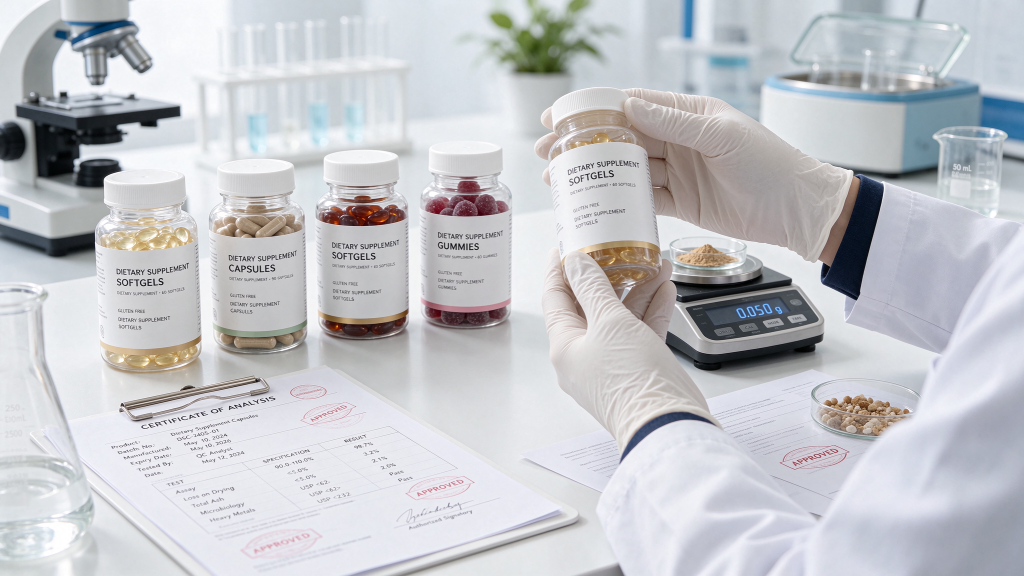
Choosing a white label supplement supplier is easy on a sales call. Auditing the formula behind the product before your brand goes on the bottle is the part most new founders skip, and it is exactly the part that turns a launch into a refund storm or, worse, a warning letter. A pretty label and a fast page load do not matter if the active ingredient is under-dosed, the ingredient list hides an allergen, or the certificate of analysis does not actually match the lot you are shipping. This guide walks through the audit checklist we wish every new Shopify supplement brand had on day one, so you can put your name on a formula you would hand your own family.
Start with the Ingredient Deck, Not the Marketing Sheet
The first document you should ask for from any white label supplement supplier is the full ingredient deck for the SKU, not the one-page sell sheet. The sell sheet tells you what the marketing team wants you to know. The ingredient deck tells you what is actually in the capsule. You are looking for the exact source of each active, the dose per serving, the form of the ingredient, and the place of manufacture.
- Source and origin. Where does the raw material come from? Curcumin from turmeric grown in one region is not the same quality as another. Ashwagandha root extract should specify Withania somnifera and the region. Fish oil should specify wild-caught versus farmed and the species.
- Form and delivery. Is the magnesium oxide, glycinate, or citrate? The form changes absorption dramatically. Is the curcumin combined with piperine or a micellar delivery system? Turmeric with no absorption enhancer is largely an expensive placeholder.
- Dose per serving. Compare the dose on the deck against clinical reference points in the public domain. Many “proprietary blends” hide the active dose inside a lump sum that also includes filler. If you cannot see the active dose, treat it as under-dosed.
- Excipients and flow agents. Look for magnesium stearate, silicon dioxide, titanium dioxide, carrageenan, and artificial colors. A growing number of customers actively filter these out, and they show up in negative reviews fast.
When a supplier resists sending the full deck and only sends the marketing PDF, that is your answer. A manufacturer confident in its formula will hand over the deck without hesitation.
Read the Certificate of Analysis Like an Investigator
The certificate of analysis (CoA) is the single most important document in your audit, and most founders either do not ask for it or glance at it once and file it away. A real CoA is lot-specific, signed by a qualified analyst, and issued by a lab that is independent of the manufacturer. A CoA that is generic, undated, or issued by the manufacturer’s own in-house lab without accreditation is worth less than the paper it is printed on.
- Lot number match. The CoA you receive must reference the exact lot number that will be packed into your branded bottles. If the supplier sends you a “representative” CoA from a different lot, ask for the one tied to your production run.
- Identity and assay. The assay result should confirm the active ingredient is present at the label claim, typically within a defined tolerance (often 90%–110%). Below that, the product is mislabeled.
- Heavy metals and microbes. Look for lead, arsenic, cadmium, mercury, total aerobic count, yeast and mold, E. coli, salmonella, and coliforms. Heavy metal limits should meet USP or comparable pharmacopeial standards.
- Contaminant and solvent residue. Especially important for extracts and tinctures. Residual solvents, pesticides, and mycotoxins should all be within limits.
- Expiration and retest date. The CoA should align with the best-by date printed on your label. Bottles shipping with six months or less of shelf life erode customer trust and inflate returns.
Keep a copy of every CoA for every lot you sell. If a customer or a regulator ever asks, you want a clean paper trail that ties each bottle on a shelf to a verified lab result.
Third-Party Testing and Certification: What Actually Matters
“Third-party tested” is one of the most overused phrases on supplement labels. Before you print it on your bottle, understand what the certification actually covers. A cGMP registration, a Good Manufacturing Practice audit, and an independent lab assay are three different things, and only one of them proves the product in the bottle matches the label.
- cGMP compliance. The manufacturer should operate under current Good Manufacturing Practices for dietary supplements, audited and registered. This covers the facility, the process, and the documentation, but it does not by itself prove a specific lot is clean.
- Independent lab verification. A separate, accredited laboratory should test each finished lot for identity, potency, and contaminants. This is the layer that actually protects your brand.
- Third-party certifications. Look for NSF, USP Verified, Informed-Sport, or similar seals when relevant. These are meaningful because they involve unannounced audits. “Made in a cGMP facility” is not the same as “certified by NSF.”
- Supplement Facts panel alignment. Every value on the Supplement Facts panel should be traceable back to a tested result. If the panel says 500 mg of magnesium, the assay should confirm 500 mg per serving within tolerance.
At NutFill, strict batch inspection and lot-level CoA review are built into the workflow before any white-label order is packed, which is part of why Shopify sellers can launch without carrying inventory or absorbing audit cost themselves. You still want to review the documents for your own records, but the supplier should be doing the heavy lifting for you.
Allergen Statements, Label Compliance, and Ingredient Disclosures
Allergen mislabeling is one of the fastest ways to get a product recalled and a customer harmed. Even if your formula does not intentionally contain a major allergen, cross-contamination during manufacturing is a real possibility, and that must be disclosed on the label.
- Major allergens. Tree nuts, peanuts, soy, dairy, eggs, wheat, fish, and shellfish must be clearly identified when present. If the facility processes them, a “may contain” or “manufactured in a facility that also processes” statement is required.
- Dietary claims. “Vegan,” “vegetarian,” “gluten-free,” “non-GMO,” and “kosher” all carry specific expectations. If you claim vegan, the capsule shell must be plant-based and the excipients must be vegan-friendly. “Gluten-free” has a defined threshold. Do not claim it without verification.
- Prop 65 and state disclosures. California Proposition 65 warnings may be required for certain ingredients at certain levels. A supplier that regularly ships to the U.S. market should handle this for you, but confirm it.
- Net quantity and serving size. The Supplement Facts panel, the serving size, the number of servings per container, and the net weight must all be accurate and match the filled bottle, not the theoretical formula.
Ask the supplier for a print-ready label proof that includes the Supplement Facts panel, the allergen statement, the distributor line, and the required disclaimer. Review it against their ingredient deck before approval. A label typo is not a cosmetic issue; it is a compliance issue.
Dose Adequacy: Why Under-Dosing Is the Silent Brand Killer
Most supplement brands fail not because their product is dangerous, but because it does nothing. Under-dosed formulas produce neutral reviews, weak repeat purchase rates, and a quiet churn that looks like marketing failure but is actually a product failure. When you audit a formula, benchmark each active against the doses used in published studies and compare them to what is in the bottle.
| Ingredient | Typical Effective Range | Red Flag to Watch For |
|---|---|---|
| Ashwagandha extract | 300–600 mg standardized root extract, taken twice daily | Generic “ashwagandha root powder” at 100 mg with no KSM-66 or Sensoril standardization |
| Omega-3 fish oil | 1,000–2,000 mg combined EPA+DHA per day | “Fish oil 1,000 mg” with only 100 mg of actual EPA+DHA |
| Magnesium (glycinate/citrate) | 200–400 mg elemental magnesium per day | Magnesium oxide at 1,000 mg but only 140 mg elemental |
| Vitamin D3 | 1,000–5,000 IU per day depending on baseline | 400 IU tucked into a multivitamin “for the whole family” |
If the formula you are evaluating sits well below these ranges, you are not buying a supplement; you are buying a placebo with your label on it. Profit margins in this industry can reach 70–85%, but that math only works when repeat buyers come back because the product actually works. An under-dosed formula inflates your customer acquisition cost and shrinks your lifetime value.
Test Orders: Audit the Product the Customer Will Actually Receive
Before you promote a SKU to your audience, order it yourself and put it on your own desk. This is the cheapest quality control step you will ever take. Open the bottle. Check the seal. Taste the gummy. Break open a capsule. Compare the bottle weight against the label. Read the label for typos. Confirm the lot number matches the CoA you were sent.
- Seal and packaging integrity. The induction seal should be intact, the cap should snap, and the label should be applied straight without bubbling.
- Sensory check. Softgels should not stick together. Powders should not clump. Gummies should not be melted or fused. Capsules should not taste rancid, which signals oxidized oil.
- Physical consistency. Bottles should be filled to the correct level. Capsules should all look identical. Count the servings.
- Unboxing experience. The insert, the bottle design, and the outer mailer set the tone for the review your customer is about to write.
One test order catches more problems than a dozen sales calls. With a dropshipping model like the one NutFill runs, you can place test orders under your own brand before connecting your live store, confirm the unboxing feels right, and only then turn on customer traffic. There is no minimum order quantity forcing you to commit to a thousand bottles of a formula you have never held.
FAQ: Auditing a White Label Supplement Formula
How much does it cost to audit a supplement formula myself?
If your supplier provides the ingredient deck, the lot-specific CoA, and cGMP documentation, the audit itself costs you only time. The optional layer is an independent third-party re-test, which typically runs a few hundred dollars per SKU per lot and is worth it for your flagship products before a major launch.
What is the difference between a white label and a private label supplement?
In practice, both mean your brand goes on a pre-existing formula. White label usually implies a stock formula with a few label customization options and no minimum order; private label can imply more customization of the formula itself. For Shopify sellers starting out, a no-MOQ white label model lets you test demand without tying up capital in inventory.
Can I trust a CoA that the manufacturer sends from their own lab?
Not by itself. An internal lab result is a process document, not independent verification. You want a CoA issued by an accredited, third-party laboratory, signed by an analyst, tied to a specific lot number, and covering identity, potency, heavy metals, and microbial contaminants.
How do I know if a dose is clinically meaningful?
Compare the dose on the Supplement Facts panel to the doses used in published research for that ingredient. If the product delivers a fraction of the studied dose, the customer is unlikely to experience the effect they are buying the product for. When in doubt, choose a different SKU.
Conclusion
When you evaluate any white label supplement supplier, treat the formula audit as a non-negotiable step, not a checkbox. Pull the ingredient deck, demand a lot-specific CoA, verify third-party testing, read the allergen and dietary claims, benchmark the active doses against what actually works, and order a test bottle before you spend a dollar on ads. The supplier that makes this process easy is a partner; the supplier that resists it is a liability. Platforms like NutFill are built around this workflow, with no MOQ, strict batch inspection, and 6–10 day shipping to U.S. and EU customers, so you can launch a branded line through the Shopify app at https://apps.shopify.com/nutfill without becoming a quality-control expert overnight. But even on a platform that does the heavy lifting, you remain the person whose name is on the bottle. Audit like it, and your brand will outlast the founders who skipped this step.
